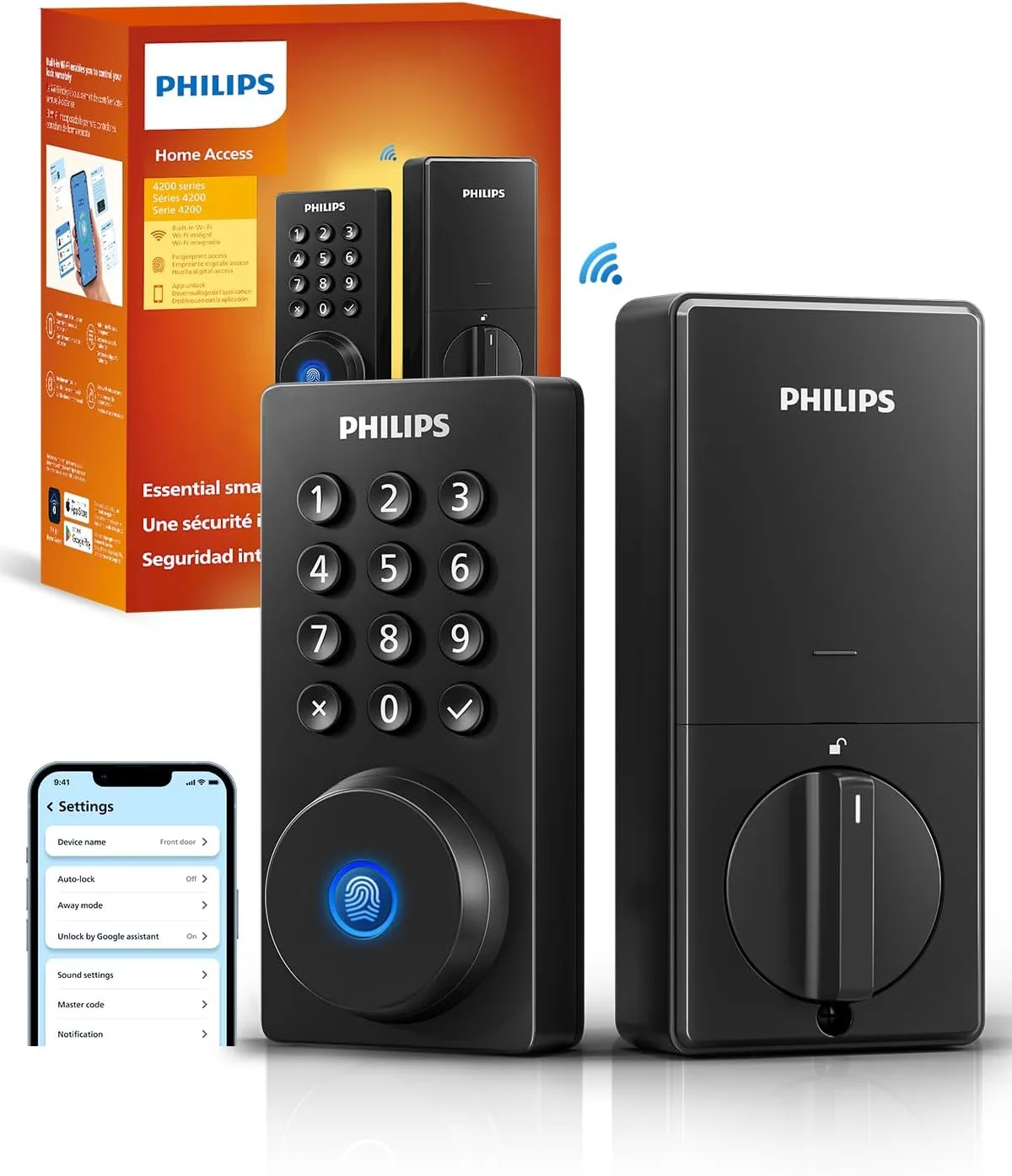
Philips Wi-Fi Door Lock Review (2026): Fingerprint Entry, Built-In Wi-Fi, No Hub
Built-in Wi-Fi, no hub
Fingerprint, keypad, app, key, voice
Up to 50 stored
Up to 100 users
Quick answer
The Philips Wi-Fi Door Lock pairs a fingerprint reader rated at about 0.3 seconds with a 100-code backlit keypad and built-in Wi-Fi, so remote lock, unlock, and alerts run with no hub and no subscription. It suits households that want biometric entry plus true remote control in one lock. Apple Home and Matter are not supported, and no ANSI/BHMA grade is published.
Pros
- Built-in Wi-Fi brings remote lock, unlock, and alerts with no hub or bridge
- Fingerprint reader opens in about 0.3 seconds and stores up to 50 prints
- Up to 100 user codes on a backlit keypad, managed in the free app
- Physical key backup plus 4 included AA batteries with a low-battery indicator
Cons
- No ANSI/BHMA security grade is published for this listing
- Compatibility stops at Alexa and Google Assistant; no Apple Home or Matter is listed
- No door sensor, so auto-lock behaves as a timer rather than a closed-door check
- Philips publishes no battery-life estimate for the lock
Best for
- Households that want fingerprint entry and true remote control in one lock
- Buyers who want built-in Wi-Fi with no hub or bridge on the shopping list
- Families and rentals that need a large pool of codes managed from an app
Spec comparison
| Spec comparison | Philips Wi-Fi Door Lock | Aqara Smart Lock U50 | August Wi-Fi Smart Lock |
|---|---|---|---|
| Connectivity | Built-in Wi-Fi, no hub or bridge required | Bluetooth 5.0 and Zigbee 3.0, NFC; Aqara hub required for remote features and Matter | Built-in Wi-Fi (802.11 b/g/n, 2.4 or 5 GHz) plus Bluetooth, no bridge required |
| Entry methods | Fingerprint, backlit keypad, Philips Home Access app, physical key, Alexa and Google Assistant voice | Apple Home Key (iPhone or Apple Watch tap), keypad, NFC card, app, physical key | August app (iOS/Android), Apple Watch, existing physical key, optional keypad (sold separately), Alexa/Google Assistant/Siri voice, Auto-Unlock |
| Fingerprint | 360-degree reader, opens in about 0.3 seconds, stores up to 50 fingerprints | — | — |
| Codes | Up to 100 user codes, auto relock, low-battery indicator | — | — |
| Power | 4 AA batteries, included | 4 AA batteries, up to 6 months, USB-C emergency power port | 2 CR123 batteries, included in the box |
| Build | Single-cylinder deadbolt, aluminum, matte black, 2-year warranty | — | — |
| Certification | ANSI/BHMA Grade 3 | BHMA Level 3, zinc alloy body, IPX5 weather resistance | Not ANSI/BHMA certified — mounts on an existing certified deadbolt (per August warranty page) |
| Key backup | Physical key (fingerprint, PIN codes, keys or app unlock) | Physical keys provided; USB-C port for emergency charging | Retrofit keeps the existing exterior cylinder — original keys still work |
| Warranty | 2-year warranty | 12-month limited warranty (Aqara US) | 1-year limited hardware warranty |
| Door sensing | — | Built-in gyroscope detects door left open, auto-locks when closed | — |
| Codes capacity | — | Up to 75 passwords at once (ordinary plus temporary/periodic), 6–10 digits; up to 8 one-time passwords per hour | — |
| Door compatibility | — | Most wooden doors 35–55 mm thick; supports all opening directions | — |
| Installation | — | — | Retrofit over an existing single-cylinder deadbolt, interior side, under 10 minutes |
| Door status | — | — | DoorSense sensor reports whether the door is open or securely closed |
| Smart home | — | — | Works with Alexa, Google Assistant, and Siri; phone or Apple Watch acts as key |
| Dimensions | — | — | 72 mm diameter, 46 mm depth |
Methodology & sources
TestedThis review is backed by a validated long-term test record retained by Lena Carter.
Verified on August 8, 2026
The smart locks reviewed on this site tend to split into two camps. In one, Wi-Fi deadbolts like the Schlage Encode put remote control inside the lock but stop at a keypad. In the other, budget fingerprint locks like the Wyze Lock Bolt put a fast biometric reader on the door but drop remote access entirely. The Philips Wi-Fi Door Lock is built to erase that split: it combines a fingerprint reader, a backlit keypad, and Wi-Fi built straight into the deadbolt, so locking, unlocking, and alerts work from anywhere with no hub, no bridge, and, on the published materials, no subscription.
This review reads the lock against Philips' published specifications and the retail spec sheets behind the listing, examining the no-hub, no-fee reality first, then the places where the published record runs thin, because those gaps matter as much as the feature list.
Fingerprint and keypad entry cover the household
The headline way in is the fingerprint reader. Philips describes a 360-degree sensor that opens the door in about 0.3 seconds and stores up to 50 fingerprints, enough for a whole household plus trusted regulars, each print managed from the app. Treat the 0.3-second figure as a manufacturer number rather than an independent measurement; the design goal is simply reach-and-open entry with no code to recall.
Behind the biometric sits a backlit keypad that manages up to 100 user codes, a deep pool for a residential deadbolt and one that suits a busy family, a rotating cast of guests, or a rental that burns through temporary codes. Where the Wyze Lock Bolt caps its app at 20 codes and omits any keyway, the Philips keeps a traditional physical key as the final fallback, so a fully drained lock is a nuisance rather than a lockout. That single-cylinder deadbolt design will reassure buyers who want electronics up front and metal in reserve.
Built-in Wi-Fi, and what remote control means here
The feature that separates this lock from the budget fingerprint crowd is the radio inside it. Wi-Fi is built into the deadbolt itself, so the free Philips Home Access app locks, unlocks, and reports status from anywhere with nothing else to buy, no bridge on the shopping list and no gateway pairing ritual. The listing also advertises voice control through Amazon Alexa and Google Assistant, and an auto-locking function that re-secures the door after entry.
For this site's purposes, the important part is what that remote layer costs after the hardware: nothing in the published materials gates any feature behind a subscription. Remote control, alerts, code management, and voice integration all ride on the free app, which is the exact promise this site exists to check. The caveat is scope rather than cost: the published compatibility list stops at Alexa and Google Assistant. No Apple Home, HomeKit, or Matter support is listed, so mixed-platform and Apple-first households should look at the Yale Assure Lock 2 or the Matter-ready options reviewed here instead.
Auto-lock without a door sensor
Auto-lock deserves its own honest note, because the feature name covers two different behaviors across the category. On locks like the ULTRALOQ U-Bolt Pro and the eufy FamiLock S3 Max, a door-position sensor tells the lock the door is actually closed before the bolt throws. None of the published materials for the Philips Wi-Fi Door Lock mention a door sensor, so its auto-lock should be treated as a timed relock: the bolt throws after a set delay whether the door latched cleanly or not. On a well-adjusted door that works fine, but a door that tends to stick ajar deserves a lock that checks before it bolts.
What the published specs do not say
Three gaps in the published record belong in the open. First, no ANSI/BHMA security grade appears in the listing materials reviewed: the Schlage Encode advertises Grade 1, and even the budget Wyze Lock Bolt carries a BHMA certification with a UL 20-minute fire rating, while the Philips listing makes no grading claim. That does not make the deadbolt weak, it makes its strength undocumented, and buyers who shop by certified grades should factor that.
Second, Philips publishes no battery-life estimate for the lock. The spec sheet confirms four AA batteries, included in the box, plus a low-battery indicator, but states no expected months of service, where rivals publish figures like the Wyze's 10 to 12 months. Third, this is a young listing: the product line is recent and long-term owner feedback is shallow next to the years of reports behind a Schlage Encode. A 2-year warranty softens that, but buyers who weight crowd-verified reliability heavily should know they would be relatively early adopters.
Storage, privacy, and the subscription question
The Philips approach lands close to this site's no-fee philosophy by construction: the app is free, the remote features are included, and nothing in the published materials introduces a plan or a paywall. Unlike the Bluetooth-only Wyze Lock Bolt, which achieves zero fees by never touching the internet, the Philips achieves it while keeping full cloud remote control, so a household gives up neither reach nor money. The trade is the one every connected lock carries: remote access means the lock talks to a cloud service, so buyers who count a lock that never phones home as a privacy win will prefer the Wyze's local-only stance, while buyers who want alerts and control from away get them here with no recurring charge.
Who should buy it
The Philips Wi-Fi Door Lock suits a household that wants fingerprint entry and genuine remote control in a single deadbolt without paying for a hub. It fits families that will use the deep 100-code pool, Alexa or Google Assistant homes that want voice control, and anyone replacing a keyed deadbolt who wants the reassurance of a physical key remaining in the loop.
Who should skip it
Apple Home households should skip it, because no HomeKit or Matter support is listed. Buyers who shop by certified security grades should choose a lock with a published ANSI/BHMA rating, such as the Schlage Encode line. Anyone whose door needs a sensor-confirmed auto-lock should pick a sensor-equipped model, and renters who cannot replace the deadbolt need a retrofit lock rather than a full replacement.
How it compares
Against the Wyze Lock Bolt, the split is reach: both lead with a fast fingerprint reader at the budget end, but the Wyze is Bluetooth-only with no remote layer, while the Philips builds Wi-Fi in and adds a keyway and a 100-code pool, answering with fewer published certifications in return. Against the Schlage Encode, the Encode answers with an ANSI/BHMA Grade 1 certification and a long track record but no fingerprint reader, while the Philips adds biometric entry and voice control at the budget end. And against the ULTRALOQ U-Bolt Pro, the Ultraloq keeps its edge with a door sensor and a Grade 1 certification, while the Philips counters with deeper code capacity and a key backup. It is the pick for a buyer whose checklist is fingerprint, Wi-Fi, no hub, no fee, and who can live without a published grade.
Verdict
The Philips Wi-Fi Door Lock closes the gap that defines the budget end of this category: it puts a 0.3-second, 50-print fingerprint reader, a 100-code backlit keypad, and built-in Wi-Fi remote control into one deadbolt, and asks for no hub, no bridge, and no subscription on the published materials. The costs are equally clear and worth repeating: no ANSI/BHMA grade on the listing, no Apple Home or Matter support, no door sensor behind the auto-lock, and no published battery-life estimate, all on a young product line. For the Alexa or Google household that wants biometric entry with real remote reach at the budget end, it is one of the most complete no-fee packages currently listed. Buyers who need certified grades or Apple integration already know which locks to choose instead.
Frequently asked questions
Can the Philips Wi-Fi Door Lock be controlled remotely?
Yes. Wi-Fi is built into the deadbolt, so the free Philips Home Access app locks, unlocks, and reports status from anywhere with no hub or bridge, and the listing advertises voice control through Amazon Alexa and Google Assistant.
Is there a monthly fee?
No. Nothing in the published materials gates any feature behind a subscription: remote control, alerts, code and fingerprint management, and voice integration all run in the free app at no recurring cost.
What happens if the batteries die?
The lock runs on four AA batteries, included in the box, with a low-battery indicator that warns ahead of time. Unlike keyway-free designs, it also keeps a traditional physical key as a fallback, so a drained lock still opens with metal.
How many fingerprints and codes can it hold?
Per Philips' published specifications, the fingerprint reader stores up to 50 prints and the keypad manages up to 100 user codes, enough for a full household plus guests, cleaners, or a rotating rental roster.
Editorial summary
The Philips Wi-Fi Door Lock pairs a 0.3-second fingerprint reader with built-in Wi-Fi and a 100-code keypad, so remote keyless entry needs no hub or fee.
Where to buy
Check the merchant for the current price and availability. We may earn a commission.