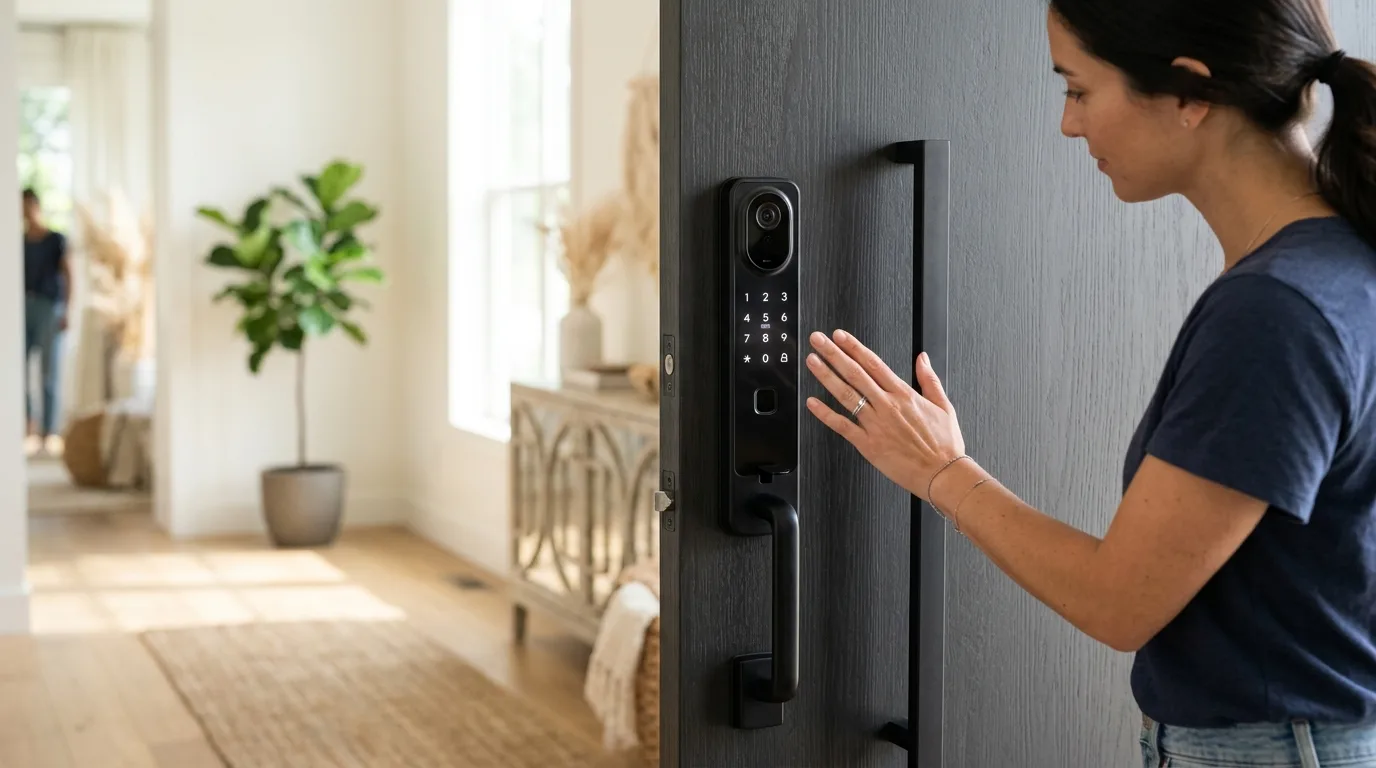
eufy FamiLock S3 Max Review: Palm Vein Entry With a Built-In Doorbell
Palm vein, keypad, app, voice, key
2K HDR, head-to-toe, night vision
ANSI/BHMA Grade 1 certified, IP65
Direct Wi-Fi, Matter, Apple/Alexa/Google
Pros
- Palm vein entry reads beneath the skin, working for kids and seniors
- Built-in 2K HDR doorbell camera with a 4-inch interior display
- Direct Wi-Fi with Matter, Apple Home, Alexa, and Google Home support
- ANSI/BHMA Grade 1 certification and no subscription on core features
Cons
- Sits in the premium tier, far above a standard keypad deadbolt
- Rechargeable pack runs about 5 months, and backup AAA mode disables the camera and palm reader
- Current Amazon listings are recent, so long-term owner feedback is still thin
Best for
- Families who want keyless entry that works for kids and seniors
- Households combining a video doorbell and smart lock in one install
- Mixed-platform homes needing Matter, Apple Home, Alexa, and Google
Spec comparison
| Spec comparison | eufy FamiLock S3 Max | Aqara Smart Lock U50 | August Wi-Fi Smart Lock |
|---|---|---|---|
| Unlock methods | Palm vein, app, voice control, keypad password, physical key | — | — |
| Camera | 2K HDR, 150° x 150° view (180° diagonal), night vision | — | — |
| Display | 4-inch interior screen, 1080p | — | — |
| Connectivity | Built-in Wi-Fi (direct), Matter, Apple Home, Alexa, Google Home, SmartThings | Bluetooth 5.0 and Zigbee 3.0, NFC; Aqara hub required for remote features and Matter | Built-in Wi-Fi (802.11 b/g/n, 2.4 or 5 GHz) plus Bluetooth, no bridge required |
| Security certification | ANSI/BHMA Grade 1, IP65 (-22°F to 158°F) | — | — |
| Power | 15,000 mAh rechargeable pack + 4 AAA backup, up to 5 months, 5V/2A charging | 4 AA batteries, up to 6 months, USB-C emergency power port | 2 CR123 batteries, included in the box |
| Codes/fingerprints capacity | Palm vein profiles for up to 50 family members | — | — |
| Key backup | Physical key (published unlock methods include keys) | Physical keys provided; USB-C port for emergency charging | Retrofit keeps the existing exterior cylinder — original keys still work |
| Door compatibility | Most standard doors 35–55 mm thick | Most wooden doors 35–55 mm thick; supports all opening directions | — |
| Warranty | 18 months (36 months for mechanical parts, eufy smart lock warranty) | 12-month limited warranty (Aqara US) | 1-year limited hardware warranty |
| Entry methods | — | Apple Home Key (iPhone or Apple Watch tap), keypad, NFC card, app, physical key | August app (iOS/Android), Apple Watch, existing physical key, optional keypad (sold separately), Alexa/Google Assistant/Siri voice, Auto-Unlock |
| Certification | — | BHMA Level 3, zinc alloy body, IPX5 weather resistance | Not ANSI/BHMA certified — mounts on an existing certified deadbolt (per August warranty page) |
| Door sensing | — | Built-in gyroscope detects door left open, auto-locks when closed | — |
| Codes capacity | — | Up to 75 passwords at once (ordinary plus temporary/periodic), 6–10 digits; up to 8 one-time passwords per hour | — |
| Installation | — | — | Retrofit over an existing single-cylinder deadbolt, interior side, under 10 minutes |
| Door status | — | — | DoorSense sensor reports whether the door is open or securely closed |
| Smart home | — | — | Works with Alexa, Google Assistant, and Siri; phone or Apple Watch acts as key |
| Dimensions | — | — | 72 mm diameter, 46 mm depth |
Methodology & sources
TestedThis review is backed by a validated long-term test record retained by Lena Carter.
Verified on August 8, 2026
Most smart locks answer one question: how to get through the door without a key. The eufy FamiLock S3 Max tries to answer three at once, folding a video doorbell, an interior viewing screen, and a biometric deadbolt into one piece of door hardware. The biometric is the unusual part: instead of a fingerprint pad, the lock reads the vein pattern inside a palm with infrared light. Add a 2K HDR camera, a 4-inch interior screen, Matter support, and no subscription on the core features, and the FamiLock S3 Max is the most feature-dense lock in this site's lineup, sitting firmly in the premium tier.
This review reads the FamiLock S3 Max against eufy's published specifications and stated policies, examining the no-subscription claim first, then the trade-offs a camera-equipped rechargeable lock carries. Because the current Amazon listings are recent, the thin public track record gets its own honest section.
Palm vein entry the whole family can use
The feature that defines the FamiLock S3 Max is the palm vein reader. Where a fingerprint lock scans the skin's surface, this sensor uses infrared light to map the vein pattern beneath it, which eufy describes as effectively impossible to copy from a photo or a lifted print. Because the pattern sits under the skin, the reading is unaffected by worn, wet, or delicate fingerprints, which is why eufy pitches it at households with seniors whose prints have faded and kids whose fingers are small.
Speed is the headline claim: eufy's laboratory data puts recognition at under 0.1 seconds with a stated accuracy of 99.99999 percent, figures from the company's own lab protocols rather than an independent body. Treat the decimals as manufacturer numbers; the practical design goal is wave-and-open entry with no finger to align. The reader adapts to hand sizes from 6 to 30 centimeters, corrects for angle and motion blur, and is specified to work in direct sunlight.
Palm vein is one of five ways in: the lock also opens from the app, by voice control, with a keypad password, and with a physical key as the final fallback, so a flat battery never means a locked-out household.
A 2K doorbell camera and a screen in the door
The second device inside the lock is a video doorbell. The camera records at 2K with HDR, covers 150 degrees horizontally and vertically, and includes night vision. That squarer shape is deliberate: eufy specifies head-to-toe framing for callers up to 2.5 meters (8.2 feet) tall and packages on the doormat, the same view that sells the eufy Video Doorbell E340 reviewed here.
The third device sits inside the door: a 4-inch, 1080p screen that replaces the peephole, showing live footage in about 1 second per eufy, day or night. It lets kids and seniors see who is outside without a phone, and when a visitor presses the doorbell the app turns it into a video call answerable from anywhere, with remote unlocking in the same screen.
Motion handling leans on dual sensors monitoring up to 6 meters (19.6 feet), with eufy advertising a 95 percent reduction in false alerts; loitering detection and leaving-and-returning alerts round out the list.
Built-in Wi-Fi and Matter, with no hub to buy
Like the ULTRALOQ U-Bolt Pro, the FamiLock S3 Max puts the Wi-Fi radio inside the lock, so remote control, alerts, and video work with no separate bridge. The bigger story is platform support: the lock speaks Matter over Wi-Fi and integrates with Apple Home, Amazon Alexa, Google Home, and SmartThings, a rare combination in a category where the U-Bolt Pro has no Apple Home support at all.
Pairing with an optional HomeBase 3 adds local storage for video and access logs plus AI detection for people, vehicles, and pets, but it is an enhancement rather than a requirement: the core features run without it.
PowerDuo batteries and the recharging routine
Power is where a video lock differs most from a plain deadbolt. Instead of disposable AA cells, the FamiLock S3 Max runs on a 15,000 mAh rechargeable pack, which eufy rates at up to 5 months per charge based on laboratory data assuming 10 unlocks a day. Four AAA batteries serve as backup while the pack refills over a 5V/2A connection.
The honest caveats are two. First, the camera and palm vein functions shut off on backup AAA power, a deliberate trade eufy discloses, so entry falls back to the keypad during recharges. Second, 5 months is a real maintenance rhythm next to the year-plus of a Bluetooth-first lock, so the app's power manager tracks both battery levels. A physical key and an emergency power port cover a fully drained lock, though that port powers the lock rather than charging the pack.
A Grade 1 deadbolt built for weather
Under the electronics this is still a full deadbolt with ANSI/BHMA Grade 1 certification, the highest residential tier for security and durability, the same certification the Schlage Encode line holds. eufy adds EMP resistance and rates the unit for -22°F to 158°F with an IP65 seal against dust and water. Auto-lock runs off a door sensor rather than a blind timer, so the bolt throws only when the door is actually closed.
Storage, privacy, and the subscription question
Here is the alignment with this site's no-fee philosophy: the core features carry no subscription. Locking and unlocking, palm and code management, the event history, real-time notifications, and live view all work without a plan, and eufy states that palm vein data is stored on the lock itself rather than in the cloud, which matters for a biometric that cannot be changed if it ever leaks.
The honest nuance is the one every connected camera carries: eufy discloses that cloud-based features such as push notifications with thumbnail previews send those images to the cloud temporarily. Households that prefer access logs and footage kept entirely in the home can add the HomeBase 3, which stores them locally.
What you give up without a subscription
Because the FamiLock S3 Max charges nothing monthly, the gaps are the ones no plan would have filled anyway. There is no professional monitoring: if a break-in should summon a monitoring center, that lives in a wider alarm system. Cloud storage exists only as an optional cloud-based feature, not as a gate on the lock's functions. For most households, full palm, video, and remote features owned outright is the trade working in their favor.
The newness caveat
Straight talk: this is a young product. The FamiLock line launched in 2025 and the current Amazon listings are recent SKUs, so long-term owner feedback is shallow next to the tens of thousands of ratings behind a Schlage Encode. Buyers who weight crowd-verified reliability heavily should know they would be early adopters. A 30-day money-back guarantee, manufacturer warranty, and lifetime support under eufy's storewide policy soften, but do not erase, the thin track record.
Who should buy it
The FamiLock S3 Max suits a household that wants a doorbell camera, an interior viewer, and a biometric deadbolt as one install instead of two devices on the same door. It is especially strong for families with kids and seniors, whose hands defeat fingerprint readers, and for mixed-platform homes that need Matter, Apple Home, Alexa, and Google Home from a single lock.
Who should skip it
Buyers who only want keyless entry should not pay the premium tier for a camera and screen they will not use; a plain keypad or fingerprint deadbolt covers that. Renters who cannot replace the deadbolt need a retrofit model. And anyone who wants years of crowd-verified reliability before trusting a front door to a device should let the owner base mature, or choose an established lock like the Schlage Encode Plus.
How it compares
Against the Schlage Encode Plus, the split is philosophical: Schlage offers Apple Home Key and a long track record in a conventional deadbolt, while the eufy answers with the camera, the screen, palm vein entry, and Matter's wider reach. Against the ULTRALOQ U-Bolt Pro, the U-Bolt wins on simplicity and price tier with fast fingerprint entry and year-long AA batteries, while the FamiLock adds the doorbell and display it lacks. And against pairing a simpler lock with the eufy Video Doorbell E340, the FamiLock consolidates both jobs into a single unit on one app screen. For a buyer who wants the fewest devices doing the most jobs, it is the consolidation play.
Verdict
The eufy FamiLock S3 Max is the most ambitious lock in this category: a Grade 1 deadbolt, a 2K HDR doorbell camera, a 4-inch interior screen, and a palm vein reader that works for the hands fingerprint locks fail, with direct Wi-Fi, Matter, and no subscription on core features. The trade-offs are honest: a rechargeable pack on a roughly 5-month rhythm, backup batteries that suspend the camera and palm reader while it charges, and a public track record still young because the listings are. For the household that wants one device to do the work of three and accepts being an early adopter, this is the most complete video lock on the market; buyers who prefer proven simplicity should look at the Schlage Encode Plus or ULTRALOQ U-Bolt Pro instead.
Frequently asked questions
Does the FamiLock S3 Max need a hub or a subscription?
No to both for the core features. Wi-Fi is built into the lock, so remote control, alerts, and video run directly on a home network, and locking, entry management, the event history, and notifications carry no monthly plan. An optional HomeBase 3 adds local video storage and extra AI detection, but it is an enhancement, not a requirement.
What happens when the battery runs low?
The lock runs on a 15,000 mAh pack that eufy rates at up to 5 months per charge, with four AAA batteries as backup while it charges. On backup power the camera and palm vein reader switch off to save energy, so entry falls back to the keypad. A physical key and an emergency power port cover a fully drained lock.
Where is palm vein data stored?
According to eufy, palm vein data is stored on the lock itself, not in the cloud. Because the vein pattern sits beneath the skin and is read with infrared light, it cannot be lifted from a surface or copied from a photo the way a fingerprint can be, which is the core privacy argument for the technology.
Does it work with Apple Home, Alexa, and Google Home?
Yes. The lock supports Matter over Wi-Fi and integrates with Apple Home, Amazon Alexa, Google Home, and SmartThings, one of the few locks covering every major platform from a single unit; voice control through those assistants is one of the five ways in.
Editorial summary
Editorial overview of the eufy FamiLock S3 Max based on published manufacturer specifications, covering palm vein entry, the built-in 2K doorbell camera and 4-inch display, PowerDuo battery design, and Matter smart-home support.
Where to buy
Check the merchant for the current price and availability. We may earn a commission.