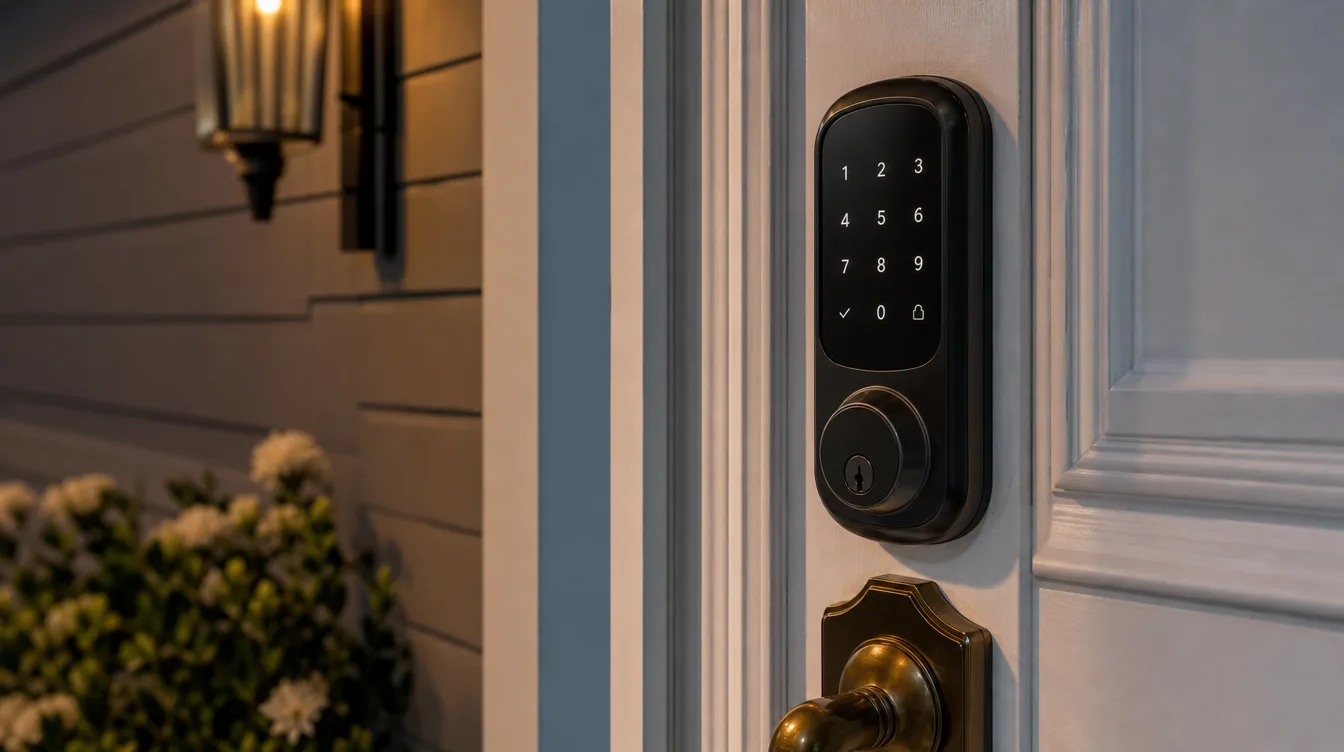
Yale Assure Lock 2 Review: Wi-Fi Keypad Entry, No Bridge, No Fee
Built-in Wi-Fi (2.4GHz), no bridge
Up to 250, schedulable
ANSI/BHMA Grade 2, IPX5
DoorSense sensor, auto-lock
Pros
- Built-in Wi-Fi needs no separate bridge, hub, or gateway to buy
- Up to 250 shareable, schedulable access codes stored on the lock
- Included DoorSense sensor enables genuine auto-lock and door-ajar alerts
- Physical key and 9V emergency terminal back up the electronics, with no subscription
Cons
- ANSI/BHMA Grade 2, a notch below the Grade 1 Schlage Encode and Ultraloq
- Apple Home Key tap-to-unlock is reserved for the pricier Assure Lock 2 Plus
- The Wi-Fi radio at the door draws more power than a Bluetooth-only lock
Best for
- Buyers who want a polished, name-brand keypad deadbolt with built-in Wi-Fi
- Households that hand out many scheduled codes to guests, cleaners, and sitters
- Alexa and Google Home homes that also want a physical key as a fallback
Spec comparison
| Spec comparison | Yale Assure Lock 2 with Wi-Fi | Aqara Smart Lock U50 | August Wi-Fi Smart Lock |
|---|---|---|---|
| Connectivity | Built-in Wi-Fi (2.4GHz) plus Bluetooth, no separate bridge required | Bluetooth 5.0 and Zigbee 3.0, NFC; Aqara hub required for remote features and Matter | Built-in Wi-Fi (802.11 b/g/n, 2.4 or 5 GHz) plus Bluetooth, no bridge required |
| Entry methods | Pushbutton keypad code, Yale Access app, physical key | Apple Home Key (iPhone or Apple Watch tap), keypad, NFC card, app, physical key | August app (iOS/Android), Apple Watch, existing physical key, optional keypad (sold separately), Alexa/Google Assistant/Siri voice, Auto-Unlock |
| Access codes | Up to 250 shareable, schedulable codes | — | — |
| Security certification | ANSI/BHMA Grade 2, IPX5 weather rating | — | — |
| Power | 4 AA batteries, up to about a year, 9V emergency contacts | 4 AA batteries, up to 6 months, USB-C emergency power port | 2 CR123 batteries, included in the box |
| Key backup | Keyed model with KW1 5-pin keyway, backup key included | Physical keys provided; USB-C port for emergency charging | Retrofit keeps the existing exterior cylinder — original keys still work |
| Door compatibility | Door thickness 1-3/8 to 2-1/4 in; backset 2-3/8 or 2-3/4 in; face bore 2-1/8 or 1-1/2 in (adapter for small bore included); edge bore 1 in | Most wooden doors 35–55 mm thick; supports all opening directions | — |
| Warranty | Lifetime limited mechanical and finish warranty for the original purchaser at the original installation; 2-year electronics | 12-month limited warranty (Aqara US) | 1-year limited hardware warranty |
| Certification | — | BHMA Level 3, zinc alloy body, IPX5 weather resistance | Not ANSI/BHMA certified — mounts on an existing certified deadbolt (per August warranty page) |
| Door sensing | — | Built-in gyroscope detects door left open, auto-locks when closed | — |
| Codes capacity | — | Up to 75 passwords at once (ordinary plus temporary/periodic), 6–10 digits; up to 8 one-time passwords per hour | — |
| Installation | — | — | Retrofit over an existing single-cylinder deadbolt, interior side, under 10 minutes |
| Door status | — | — | DoorSense sensor reports whether the door is open or securely closed |
| Smart home | — | — | Works with Alexa, Google Assistant, and Siri; phone or Apple Watch acts as key |
| Dimensions | — | — | 72 mm diameter, 46 mm depth |
Methodology & sources
TestedThis review is backed by a validated long-term test record retained by Lena Carter.
Verified on August 8, 2026
A smart lock earns the word "smart" the moment a phone can open the door from anywhere, and that is exactly where many locks quietly add a cost. The keypad is handsome, the app is free to download, and then remote control turns out to depend on a bridge plugged into a router, or on a plan to keep the history alive. The Yale Assure Lock 2, in its Wi-Fi keypad configuration, is built to close that gap. Yale puts the Wi-Fi radio inside the lock body, so remote locking, code sharing, and the door log all work with no accessory sitting between the deadbolt and the internet, and Yale charges nothing to use them. For a household that wants a polished, name-brand keypad lock but refuses a recurring bill, that built-in radio is the whole pitch.
This review reads the Assure Lock 2 against Yale's published specifications and the way its built-in Wi-Fi, DoorSense sensor, and swappable module design actually behave. Because this site exists to be honest about recurring costs, the no-bridge, no-fee claim gets examined first, then weighed against the real trade-offs, including a security certification that sits a notch below the toughest locks on this site.
Built-in Wi-Fi is the headline, because it means no bridge
The defining trait of this configuration is that Wi-Fi is built into the lock rather than bolted on. It joins a home's 2.4GHz network directly and also carries Bluetooth for close-range phone control, so remote features work with no separate bridge, hub, or gateway to buy. That matters because Yale sells the Assure Lock 2 in several connectivity flavors, and the cheaper ones on the shelf are cheaper precisely because remote access depends on an add-on Wi-Fi module or a smart-home hub you supply. This version folds the radio in, so the purchase gets you locking, unlocking, code management, and the access log from anywhere with nothing else to add.
The practical payoff is the ordinary stuff that makes a smart lock worth having. A guest is arriving early; a code can be created and sent from a desk. The question of whether the door actually locked can be answered from the app, and the bolt thrown remotely if it was not. A delivery is due; a notification confirms the door opened and closed. None of it depends on being home, on a hub staying online, or on a plan being current. The Yale Access app is free, and the remote features it exposes are free with it.
There is an honest cost to name, and it is the one every Wi-Fi lock pays. A Wi-Fi radio is hungrier than a Bluetooth-only one, so a connected lock trades some battery life for its independence. Yale rates the four AA cells at up to about a year of typical use, which is respectable for a Wi-Fi lock, and both the app and the keypad warn well before the batteries die. If they are ignored to the point of a dead lock, exterior contacts accept a 9V battery to jump the keypad long enough to enter a code, so a flat battery never means a locked-out household.
The keypad and up to 250 access codes
Entry happens through a backlit pushbutton keypad. The physical buttons are a deliberate choice over a glass touchscreen: they give a positive click in the cold, they are easy to find by feel at night, and there is no smudge trail across a glossy panel pointing an onlooker at the digits of a code. A four-to-eight-digit code opens the door, and the lock relocks from the outside without waking a phone.
Where the Assure Lock 2 pulls ahead of much of the field is the sheer number of codes it manages. It stores up to 250 access codes, and each can be scheduled. A cleaner holds a code that only works Tuesday mornings; a weekend guest gets one that expires automatically on Monday; a contractor is handed temporary access that is revoked the instant the job ends, all from the app, with no need to meet in person or reset a shared code afterward. Every one of those codes lives on the lock itself, so entry keeps working during an internet outage; the Wi-Fi is for remote management and alerts, not for the basic act of unlocking. That local-first design means a router reboot never turns the door into a paperweight.
DoorSense and genuine auto-lock
Yale includes its DoorSense sensor in the box, and it is the detail that makes auto-lock trustworthy rather than a guess. Auto-lock on a lock without a door sensor is a blind timer: it throws the bolt a set number of seconds after unlocking, whether or not the door is actually shut, which can mean the bolt driving into the door edge while someone carries in groceries. DoorSense tells the lock whether the door is genuinely open or closed, so the bolt can throw only once the door is shut, and the app can alert you if the door is left ajar. It is the same class of feature that separates a lock you trust to secure itself from one you double-check on the way to bed.
A real deadbolt, and the honest certification line
The Assure Lock 2 is a complete deadbolt that replaces the whole mechanism, keypad and cylinder included, rather than a motor clipped to the back of the old lock. That is what lets Yale certify it and keep a real, physical key beneath the keypad as the ultimate fallback, so a total electronics failure never means being locked out.
Here is the trade-off worth stating plainly, because it is the clearest reason a security-minded buyer might look elsewhere. The Assure Lock 2 carries an ANSI/BHMA Grade 2 certification, the standard residential tier. That is perfectly solid for a home, but it sits one notch below the commercial Grade 1 mark that the Schlage Encode and the ULTRALOQ U-Bolt Pro on this site both earn. Grade 1 hardware is engineered to survive more force and more cycles, so a buyer whose top priority is raw mechanical toughness should know the Assure Lock 2 prioritizes finish, features, and ecosystem polish over the highest security grade. The lock is also weather-built to an IPX5 rating for an exposed exterior door.
Storage, privacy, and the subscription question
This is the part that aligns the Assure Lock 2 with a no-fee philosophy. Unlocking, code management, the door-activity history, and push notifications are all delivered by the free Yale Access app, with no plan gating the features that make the lock smart. Access codes are stored on the lock, so basic entry keeps working during an outage, and the app adds per-user alerts so a parent can be pinged only when a child's after-school code is used and nothing else.
The honest nuance is that a Wi-Fi lock is, by definition, a cloud-connected device. Lock and unlock events pass through Yale's servers to reach a phone, so this is not the fully local, nothing-leaves-the-house model that a Zigbee lock on a private hub can offer. What the Assure Lock 2 guarantees is that the connection costs nothing beyond the hardware and that credentials live on the lock rather than being rented back to the owner. For most households weighing convenience against privacy, that is a fair middle ground.
Smart-home integrations, and the Apple Home Key gap
The Assure Lock 2 works with Amazon Alexa and Google Home, so a spoken command can lock the door or report its state, and the lock can fold into wider good-night or away routines. Apple households can control it through Apple Home, but the standout Apple convenience, tapping an iPhone or Apple Watch on the lock to unlock with a Home Key in Apple Wallet, is reserved for the separate Assure Lock 2 Plus. Anyone whose deciding feature is tap-to-unlock should budget for that step up, exactly as the Schlage Encode Plus exists above the standard Encode for the same reason. The swappable network module in the Assure Lock 2 body is also worth knowing about: it lets the lock be reconfigured for other connectivity down the line rather than being replaced outright.
Who should buy it
The Assure Lock 2 is the right lock for a homeowner who can swap a deadbolt and wants a refined, name-brand keypad with hub-free remote control and no fee. It is especially strong for a household that leans on scheduled codes, since 250 of them with per-user alerts covers a busy home of guests, cleaners, and sitters, and for anyone who wants genuine auto-lock backed by the included DoorSense sensor. Alexa and Google Home homes that also value a physical key fallback are its natural buyers.
Who should skip it
Renters who cannot legally replace the deadbolt should choose a retrofit lock that keeps the existing exterior and key. Apple devotees who want tap-to-unlock Home Key should step up to the Assure Lock 2 Plus rather than settle here. And a buyer whose single hard requirement is a commercial Grade 1 certification will be happier with a lock built to that tier, accepting whatever it gives up in polish or code capacity.
How it compares
Against the Schlage Encode reviewed here, the two locks share the best part of the pitch: built-in Wi-Fi, no hub, and no subscription. The Assure Lock 2 counters with far more access codes and an included DoorSense sensor for smarter auto-lock, while the Encode answers with a tougher Grade 1 deadbolt and Ring and Alarm.com integration. Against the Schlage Encode Plus, the split is Apple: the Encode Plus builds in Home Key, which the standard Assure Lock 2 leaves to its own Plus model. And against the ULTRALOQ U-Bolt Pro, the Ultraloq adds a fast fingerprint reader and a Grade 1 certification the Yale does not match, so the Assure Lock 2 is the pick for a buyer who prizes keypad polish, code capacity, and a trusted name over biometrics and the highest security grade.
Verdict
The Yale Assure Lock 2 in its Wi-Fi keypad form delivers the hard part of the smart-lock promise without an accessory or a subscription: it bakes Wi-Fi into a real deadbolt, manages up to 250 scheduled codes, and uses the included DoorSense sensor to lock behind you only when the door is actually shut. The honest costs are a Grade 2 rather than Grade 1 certification and the fact that Apple Home Key waits behind the pricier Plus model. For the large group that wants a polished, name-brand keypad lock with free remote features and codes it owns rather than rents, the Assure Lock 2 is one of the most livable no-fee locks on the market.
Frequently asked questions
Does the Yale Assure Lock 2 need a separate bridge or hub?
Not in this Wi-Fi configuration. The Wi-Fi radio is built into the lock, so it connects straight to a 2.4GHz home network with no bridge, hub, or gateway to buy. That is the difference from the cheaper Assure Lock 2 versions, whose remote features depend on an add-on module or a smart-home hub you supply.
Is there a monthly fee for remote access or the door log?
No. The Yale Access app is free, and it covers remote lock and unlock, code creation and sharing, the access history, and notifications with no subscription. Access codes are stored on the lock itself, so basic entry keeps working even if the internet is down.
Does it support Apple Home Key?
The standard Assure Lock 2 can be controlled through Apple Home, but tap-to-unlock Apple Home Key, using an iPhone or Apple Watch in Apple Wallet, is a feature of the separate Assure Lock 2 Plus. Apple households whose priority is tapping to unlock should choose that model instead.
How strong is the deadbolt compared with other smart locks?
It is certified to ANSI/BHMA Grade 2, the standard residential tier, which is solid for a home. That is one step below the commercial Grade 1 certification carried by the Schlage Encode and the ULTRALOQ U-Bolt Pro, so a buyer focused purely on mechanical toughness may prefer a Grade 1 lock, while the Assure Lock 2 leads on codes, ecosystem, and finish.
Editorial summary
The Yale Assure Lock 2 builds Wi-Fi into a keypad deadbolt with up to 250 shareable codes and a DoorSense sensor, so remote access and real auto-lock need no bridge and no subscription.
Where to buy
Check the merchant for the current price and availability. We may earn a commission.