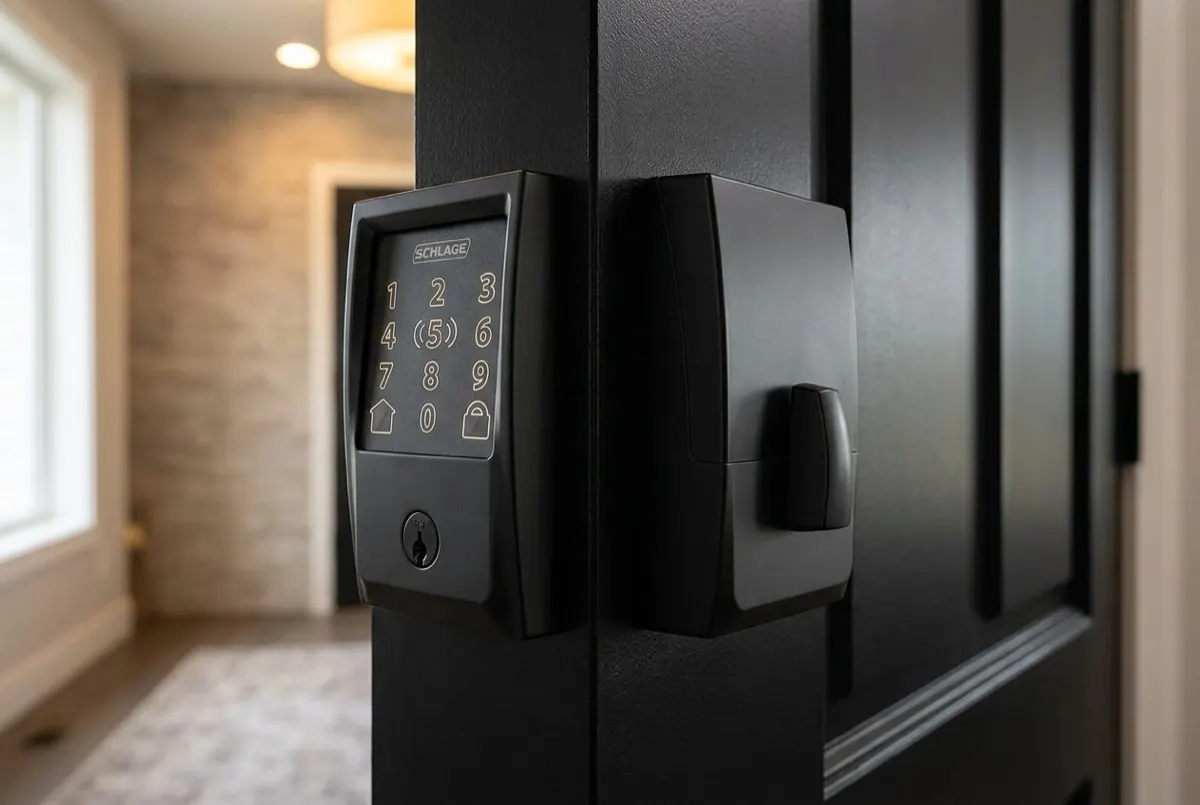
Schlage Encode Plus Review: Apple Home Key on a Hub-Free Deadbolt
Tap iPhone or Apple Watch
Wi-Fi and Bluetooth, no hub
Up to 100
ANSI/BHMA Grade 1
Pros
- Apple Home Key tap-to-unlock from iPhone or Apple Watch
- Full Apple Home plus Alexa and Google Home support
- Built-in Wi-Fi and Bluetooth with no hub and no subscription
- ANSI/BHMA Grade 1 hardware with up to 100 access codes
Cons
- Costs more than the standard Encode for features Android users cannot use
- Wi-Fi radio still means roughly twice-a-year battery changes
- Large exterior housing on the door
Best for
- Apple households that want tap-to-unlock with iPhone or Apple Watch
- Buyers who want HomeKit and keypad codes in one Grade 1 deadbolt
- Anyone who wants remote control with no hub and no monthly fee
Spec comparison
| Spec comparison | Schlage Encode Plus Smart WiFi Deadbolt | Aqara Smart Lock U50 | August Wi-Fi Smart Lock |
|---|---|---|---|
| Connectivity | Built-in Wi-Fi (2.4GHz) and Bluetooth, no hub required | Bluetooth 5.0 and Zigbee 3.0, NFC; Aqara hub required for remote features and Matter | Built-in Wi-Fi (802.11 b/g/n, 2.4 or 5 GHz) plus Bluetooth, no bridge required |
| Apple Home Key | Tap to unlock with iPhone or Apple Watch | — | — |
| Access codes | Up to 100 codes | — | — |
| Security certification | ANSI/BHMA Commercial Grade 1, Residential AAA | — | — |
| Power | 4 AA batteries | 4 AA batteries, up to 6 months, USB-C emergency power port | 2 CR123 batteries, included in the box |
| Voice assistants | Apple Home, Amazon Alexa, Google Home | — | — |
| Entry methods | Touchscreen codes (up to 100), Schlage Home app, Apple home keys (iPhone or Apple Watch tap), Alexa and Google Assistant voice, physical key | Apple Home Key (iPhone or Apple Watch tap), keypad, NFC card, app, physical key | August app (iOS/Android), Apple Watch, existing physical key, optional keypad (sold separately), Alexa/Google Assistant/Siri voice, Auto-Unlock |
| Key backup | Keyed cylinder, 5-pin tumbler C keyway, 1 key included | Physical keys provided; USB-C port for emergency charging | Retrofit keeps the existing exterior cylinder — original keys still work |
| Door compatibility | Door thickness 1-3/8 to 1-3/4 in (35–45 mm); universal backset adjusts to 2-3/8 or 2-3/4 in | Most wooden doors 35–55 mm thick; supports all opening directions | — |
| Warranty | Limited lifetime mechanical and finish warranty; limited 3-year electronics warranty | 12-month limited warranty (Aqara US) | 1-year limited hardware warranty |
| Certification | — | BHMA Level 3, zinc alloy body, IPX5 weather resistance | Not ANSI/BHMA certified — mounts on an existing certified deadbolt (per August warranty page) |
| Door sensing | — | Built-in gyroscope detects door left open, auto-locks when closed | — |
| Codes capacity | — | Up to 75 passwords at once (ordinary plus temporary/periodic), 6–10 digits; up to 8 one-time passwords per hour | — |
| Installation | — | — | Retrofit over an existing single-cylinder deadbolt, interior side, under 10 minutes |
| Door status | — | — | DoorSense sensor reports whether the door is open or securely closed |
| Smart home | — | — | Works with Alexa, Google Assistant, and Siri; phone or Apple Watch acts as key |
| Dimensions | — | — | 72 mm diameter, 46 mm depth |
Methodology & sources
TestedThis review is backed by a validated long-term test record retained by Lena Carter.
Verified on August 8, 2026
The Schlage Encode Plus exists for one sentence that the standard Encode cannot say: tap an iPhone or Apple Watch to the keypad and the door unlocks. That feature is Apple Home Key, and it is the reason this lock sits at the top of Schlage's consumer range. Everything else the Plus offers is a match for its cheaper sibling, so the entire buying decision hinges on whether a household lives inside Apple's world or outside it. For the people who tap a phone to board a train or pay for coffee, extending that same reflex to their own front door is the closest a smart lock has come to feeling invisible.
This review evaluates the Encode Plus against Schlage's published specifications, the Apple Home Key documentation, and the ANSI/BHMA certification that both Encode models carry. The aim is to be precise about what Home Key actually does, how the Plus behaves for someone who ignores Apple entirely, and whether the step up from the standard Encode is money well spent or a feature paid for and never used.
What Apple Home Key actually does
Apple Home Key turns a house key into a credential stored in the Apple Wallet, right next to transit passes and payment cards. Setup happens through the Apple Home app: the lock is added as a HomeKit accessory, and a Home Key is provisioned to every iPhone and Apple Watch on the household's Apple account. From then on, unlocking is a tap. Holding the device near the lock's touchscreen triggers a near-field communication handshake, the bolt retracts, and Wallet flashes a confirmation. There is no app to open, no code to type, and no fingerprint to register.
Two details make the experience better than it first sounds. The first is Express Mode, which lets the tap work without Face ID or a passcode, so an iPhone does not even need to be woken to open the door; the credential is authorized in advance and the tap alone is enough. The second is that the Home Key rides on the same secure element that protects Apple Pay, and it keeps working for hours even after a phone's battery reports empty, thanks to a power reserve. A dead-looking phone can still let someone in, which quietly removes one of the classic anxieties of phone-based entry.
Home Key does not replace the keypad or the physical key; it joins them. The touchscreen, the up-to-100 access codes, and the emergency keyway all remain, so a visitor without an iPhone is never stranded. Home Key simply becomes the fastest path for the residents who carry Apple hardware, while everyone else uses a code.
Built-in Wi-Fi and Bluetooth, still no hub
Like the standard Encode, the Plus carries its own radios and needs no bridge or gateway. It houses both Wi-Fi and Bluetooth inside the lock body: the Bluetooth handles close-range tasks and the Home Key handshake, while the 2.4GHz Wi-Fi provides the remote reach that lets the Schlage Home app lock the door or issue a code from anywhere. The absence of a hub is worth restating because HomeKit locks have historically leaned on a home hub such as a HomePod or Apple TV to be reachable away from home. The Encode Plus is reachable through Schlage's own Wi-Fi path regardless, and an Apple home hub, if present, extends the HomeKit automations rather than being the only lifeline.
That dual-radio independence carries the same battery consequence as the standard model. Four AA cells drive the motor, screen, and radios, and Schlage rates them at up to six months. A Wi-Fi lock trades battery longevity for hub-free convenience, and the Plus makes exactly that trade. The app tracks the charge and warns early, and exterior contacts accept a 9V jump to open a fully drained lock, so the practical risk of a lockout stays low.
Two ecosystems, one lock
The Encode Plus is unusual in speaking fluently to both Apple and the rest of the smart-home market at once. On the Apple side, it is a full HomeKit accessory: the Apple Home app shows lock state, drives automations, and manages Home Key. On the other side, it works with Amazon Alexa and Google Home for voice control and routines, and it retains the Schlage Home app as a neutral control surface that any phone can use.
This matters in mixed households, which are common. One partner may run an iPhone and prefer tapping to unlock through Apple Home, while another uses Android and a keypad code, and a smart display in the kitchen might be an Amazon Echo Show. The Encode Plus serves all three without forcing anyone onto a single platform, and none of those paths asks for a subscription. The Schlage Home app is free, HomeKit is free, and the Alexa and Google skills are free.
HomeKit automations in practice
Home Key is the feature that sells the Plus, but full HomeKit support is what makes it live in an Apple home rather than merely tolerate one. Inside the Apple Home app, the lock becomes an accessory that scenes and automations can read and control. A goodnight scene can confirm the deadbolt is thrown at the same time it turns off the lights and lowers the thermostat. An automation can lock the door automatically when the last family member's iPhone leaves a geofenced radius around the house, and unlock as someone arrives, so the door manages itself around the people who live there.
The status flows the other way as well. Because HomeKit knows whether the bolt is locked, other accessories can react to it: unlocking the front door in the evening can trigger the entry lights to come on, or a Home app notification can flag that the door was unlocked while everyone is out. These are the kinds of routines that make a smart lock feel like part of a system instead of a gadget bolted to the door, and they run on the free Apple Home platform. For a household that already automates lights and climate through Apple Home, folding the front door into those same scenes is the payoff that the standard Encode, with no HomeKit, simply cannot offer.
Security and the built-in alarm
Nothing about the Plus's convenience softens its hardware. It shares the Encode family's ANSI/BHMA A156.36 Commercial Grade 1 and residential AAA certification, the highest residential marks for security, durability, and finish, and it carries the same built-in alarm technology that senses activity and can flag attempts to force the door. The bolt is full-throw, the keyway remains as a mechanical fallback, and the exterior slab is the recognizable heavy Schlage housing. A buyer stepping up for Home Key is not stepping down on toughness; the Plus is every bit the deadbolt the standard Encode is.
On privacy, the same honest framing applies as with any Wi-Fi lock. Remote events travel through the cloud to reach a phone, so this is not a fully local device, but Home Key itself is handled by Apple's secure element and the credential lives in the Wallet rather than on a rented server. Access codes are stored on the lock, so entry survives an internet outage. The convenience is real, and it does not come wrapped in a monthly bill.
Installation and the lighted keypad
The Plus installs like a standard deadbolt, which keeps a premium smart lock within reach of a screwdriver and a spare half hour. It fits the common door prep, doors from 1-3/8 to 1-3/4 inches thick with a 2-1/8-inch bore, and its latch handles either backset and either swing direction, so a home swapping out an ordinary keyed deadbolt generally reuses the existing holes. Setup then continues in software: the lock is added to the Schlage Home app for Wi-Fi and to the Apple Home app for HomeKit and Home Key, and the door-handing calibration teaches the motor which way locks. The one step worth not rushing is seating the bolt so it throws cleanly by hand before power is applied, since a bolt fighting the frame is the usual cause of a straining motor.
The keypad itself is a lighted, fingerprint-resistant capacitive touchscreen. The digits illuminate only when the surface is woken, so there are no worn key marks pointing a passerby at the numbers of a code, and the resistant coating keeps the smudge trail that plagues glossy panels from advertising which four keys get pressed. A single touch of the Schlage logo throws the bolt on the way out. For the residents carrying Apple hardware, the keypad becomes the backup rather than the primary path, but it is there for guests, for a dead-and-un-reserved phone, or for anyone in the household on Android, and it is every bit as capable as the keypad on the standard Encode.
Access codes and managing guests
Home Key gets the attention, but the up-to-100 access codes are what let the Plus serve people who will never own an iPhone. Codes are created and revoked from the Schlage Home app, and each can be shaped to a purpose: a permanent code for a family member, a recurring code for a housekeeper limited to certain days and hours, or a one-time code for a contractor that stops working the moment the job is done. None of that requires meeting anyone in person or changing a shared secret afterward, which is the recurring weakness of a single code everyone knows.
The management picture becomes especially useful in a household that mixes Home Key users with code users. An Apple owner taps to enter and leaves no code to leak; a dog walker holds a scheduled code that the app can pull the instant the arrangement ends; a weekend guest gets a code that expires on its own. Per-user notifications tie into all of it, so an alert can fire only when a specific person's code opens the door. Because every code lives on the lock rather than in the cloud, entry keeps working through an internet outage, and the app's activity history records which credential opened the door and when, giving a clear, subscription-free account of the comings and goings at the front entrance.
Living with it day to day
In practice the Plus rewards Apple households with a routine that stops feeling like technology. An Apple Watch on a wrist means groceries in both hands still open the door with a bump of the forearm against the keypad. Guests get a code from the app. The access log names who came and went, and push notifications land in real time. Battery replacement is the only chore, and even that is a twice-a-year, tool-free swap that preserves all settings.
For an Android-centric household, the honest assessment is different. Strip away Home Key and HomeKit and the Plus behaves like a standard Encode that happens to cost more. The keypad, codes, Wi-Fi, alarm, and Alexa or Google control are all still there and all still excellent, but the premium was paid for two headline features that an Android phone cannot use. That is not a flaw in the lock; it is a mismatch between the buyer and the product.
Reliability over the long run mirrors the standard Encode, because the two share the same motor, bolt, and cylinder. Firmware updates flow through the Schlage Home app to keep the connectivity and integrations current, and because the door-handing, codes, and preferences are written to the lock rather than to a phone, a battery swap or a software update never wipes the setup. The Apple Home pairing and the Home Key credentials likewise persist through a routine battery change, so the twice-a-year cell replacement stays a five-minute chore rather than a re-provisioning session. It is the kind of stability that lets a household stop thinking about the lock, which is the highest compliment a front door can earn.
Encode versus Encode Plus: which to buy
The two locks share hardware, certification, keypad, code capacity, the built-in alarm, hub-free Wi-Fi, and freedom from subscriptions. The Plus adds exactly two things: Apple Home Key tap-to-unlock and full Apple HomeKit support, along with the built-in Bluetooth radio that enables the Home Key handshake. That makes the choice unusually clean. A household with iPhones and Apple Watches that wants to tap its way inside should buy the Plus and will use the difference every single day. A household on Android, or one that simply never intends to touch Apple Home, should buy the standard Encode and put the savings toward a second lock or a doorbell, because the Plus's marquee features would sit permanently idle.
Who should buy it
The Encode Plus is the clearest pick for anyone whose phones and watches are Apple. If tapping to unlock, managing the lock from the Apple Home app, and folding it into HomeKit scenes sounds like the point, this is the lock built for exactly that, and it delivers all of it with no hub and no fee. It is also a fine choice for a mixed household that wants one lock to satisfy an Apple user, an Android user, and an Alexa speaker simultaneously.
Who should skip it
An Android-only home should skip the Plus and buy the standard Encode, which is identical in the ways that will actually be used. Buyers who want the lowest cost for keyless entry, or who are indifferent to HomeKit and Home Key, gain nothing from the premium. And anyone seeking a fully local, cloud-free lock or the longest battery life should look outside the Wi-Fi category entirely, as the Plus makes the same convenience-for-power trade as its sibling.
How it compares
Against the standard Schlage Encode, the Plus is the same excellent deadbolt plus Apple Home Key and HomeKit, and the decision is purely about Apple ownership. Against Apple-friendly rivals like the Level Lock+ with Home Key, the Encode Plus counters with a visible keypad and hub-free Wi-Fi where Level hides all its hardware inside the door but leans harder on a phone and an Apple home hub for remote reach; the Encode Plus is the more self-sufficient choice for households that still want a keypad and codes. Against the Yale Assure Lock 2, the split again comes down to built-in radios and Apple support: the Encode Plus bundles Wi-Fi, Bluetooth, and Home Key together, while Yale spreads capabilities across optional modules.
Verdict
The Schlage Encode Plus is the standard Encode with an Apple accent, and that accent is transformative for the right owner. Apple Home Key makes the front door as tap-friendly as a phone-based transit pass, HomeKit brings the lock into Apple's automation world, and both arrive on top of Grade 1 hardware with hub-free Wi-Fi and no subscription anywhere in sight. The only real question is the buyer's phone. For an Apple household, the Plus is worth every bit of its premium and is among the best smart locks available. For anyone outside that ecosystem, the money is better spent on the standard Encode, which is the same lock in every way that will ever be used.
Editorial summary
The Schlage Encode Plus adds Apple Home Key tap-to-unlock and full HomeKit support to a hub-free, subscription-free Grade 1 Wi-Fi deadbolt.
Where to buy
Check the merchant for the current price and availability. We may earn a commission.