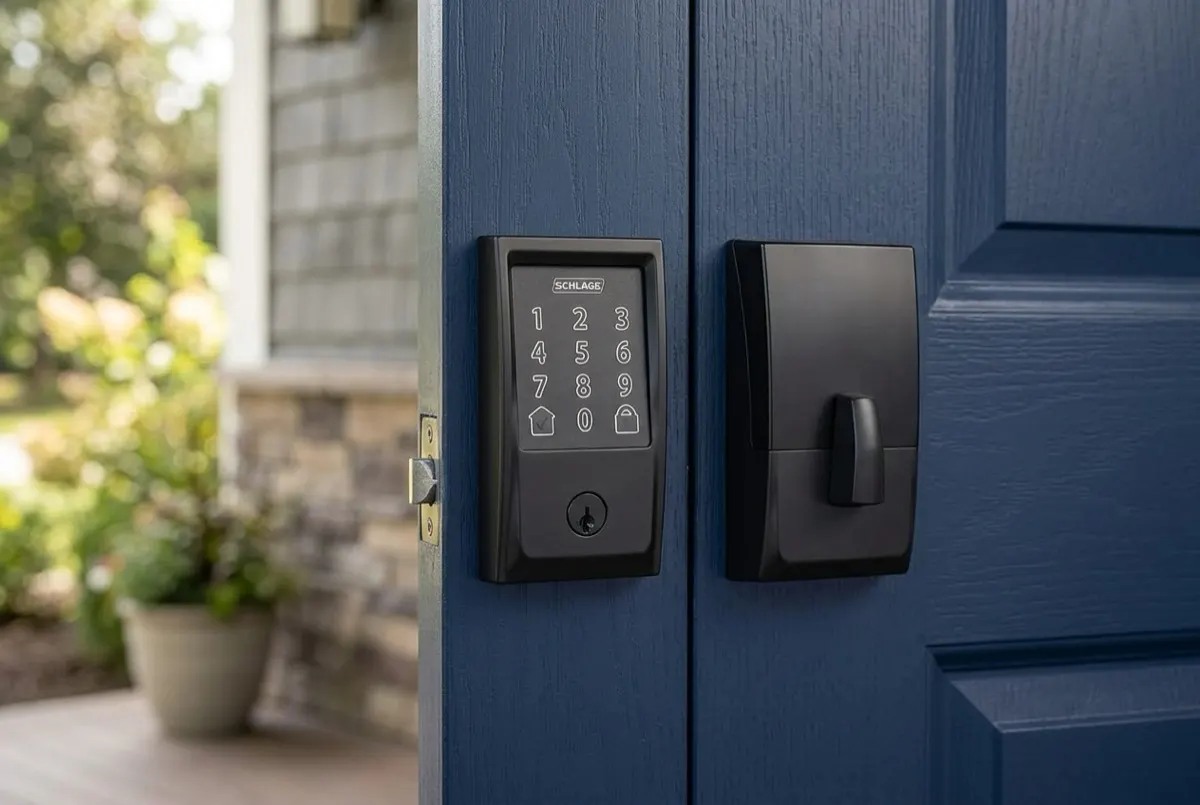
Schlage Encode Review: Wi-Fi Deadbolt With No Hub and No Subscription
Built-in Wi-Fi (2.4GHz), no hub
Up to 100
ANSI/BHMA Grade 1
4 AA batteries
Pros
- Built-in Wi-Fi with no bridge, hub, or gateway to buy
- ANSI/BHMA Grade 1, the strongest residential security certification
- Up to 100 access codes stored on the lock, free of any subscription
- Built-in alarm technology flags forced-entry attempts
Cons
- No Apple HomeKit or Home Key support on this model
- Chunky exterior housing is larger than a keypad-free deadbolt
- Wi-Fi radio drains batteries faster than a Bluetooth-only lock
Best for
- Homeowners who want a full deadbolt replacement, not a retrofit
- Buyers who refuse a monthly fee for basic lock features
- Alexa and Google Home households
Spec comparison
| Spec comparison | Schlage Encode Smart WiFi Deadbolt | Aqara Smart Lock U50 | August Wi-Fi Smart Lock |
|---|---|---|---|
| Connectivity | Built-in Wi-Fi (2.4GHz), no hub required | Bluetooth 5.0 and Zigbee 3.0, NFC; Aqara hub required for remote features and Matter | Built-in Wi-Fi (802.11 b/g/n, 2.4 or 5 GHz) plus Bluetooth, no bridge required |
| Access codes | Up to 100 codes | — | — |
| Security certification | ANSI/BHMA Commercial Grade 1, Residential AAA | — | — |
| Power | 4 AA batteries | 4 AA batteries, up to 6 months, USB-C emergency power port | 2 CR123 batteries, included in the box |
| Voice assistants | Amazon Alexa, Google Home | — | — |
| Entry methods | Touchscreen codes (up to 100), Schlage Home app with built-in Wi-Fi, Alexa and Google Assistant voice, physical key | Apple Home Key (iPhone or Apple Watch tap), keypad, NFC card, app, physical key | August app (iOS/Android), Apple Watch, existing physical key, optional keypad (sold separately), Alexa/Google Assistant/Siri voice, Auto-Unlock |
| Key backup | Keyed cylinder, 5-pin tumbler C keyway, 1 key included | Physical keys provided; USB-C port for emergency charging | Retrofit keeps the existing exterior cylinder — original keys still work |
| Door compatibility | Door thickness 1-3/8 to 1-3/4 in (35–45 mm); universal backset adjusts to 2-3/8 or 2-3/4 in | Most wooden doors 35–55 mm thick; supports all opening directions | — |
| Warranty | Limited lifetime mechanical and finish warranty; limited 3-year electronics warranty | 12-month limited warranty (Aqara US) | 1-year limited hardware warranty |
| Certification | — | BHMA Level 3, zinc alloy body, IPX5 weather resistance | Not ANSI/BHMA certified — mounts on an existing certified deadbolt (per August warranty page) |
| Door sensing | — | Built-in gyroscope detects door left open, auto-locks when closed | — |
| Codes capacity | — | Up to 75 passwords at once (ordinary plus temporary/periodic), 6–10 digits; up to 8 one-time passwords per hour | — |
| Installation | — | — | Retrofit over an existing single-cylinder deadbolt, interior side, under 10 minutes |
| Door status | — | — | DoorSense sensor reports whether the door is open or securely closed |
| Smart home | — | — | Works with Alexa, Google Assistant, and Siri; phone or Apple Watch acts as key |
| Dimensions | — | — | 72 mm diameter, 46 mm depth |
Methodology & sources
TestedThis review is backed by a validated long-term test record retained by Lena Carter.
Verified on August 8, 2026
Most smart locks arrive with an asterisk. The keypad is elegant, the app is polished, and then a line in the setup guide explains that remote control only works once a separate bridge is plugged into a router, or once a monthly plan is active. The Schlage Encode Smart Wi-Fi Deadbolt is built to erase that asterisk. Schlage puts the Wi-Fi radio inside the lock body itself, so a phone anywhere in the world can lock the door, hand out a code, or read the access log without any accessory sitting between the deadbolt and the cloud. For a household that wants keyless entry but bristles at recurring charges, that single design decision is the whole story.
This review reads the Encode against Schlage's published specifications, the Schlage Home app documentation, and the ANSI/BHMA certification that governs residential deadbolts. The goal is to explain what the hardware actually guarantees, where the marketing language quietly narrows, and who is served best by the standard Encode rather than the pricier Encode Plus that sits above it in the range.
A real Grade 1 deadbolt, not a retrofit
The first thing to understand is that the Encode is a complete deadbolt, not a motor clipped onto the back of the one already on the door. Retrofit locks such as the August Wi-Fi Smart Lock keep the existing exterior hardware and key, automating only the interior thumbturn. That approach is brilliant for renters because nothing visible changes, but it inherits whatever cylinder the landlord installed. The Encode replaces the entire mechanism, exterior keypad included, and that is what lets Schlage certify it the way it does.
Schlage states that the Encode is certified to ANSI/BHMA A156.36 Commercial Grade 1 and to the residential AAA standard, the highest marks the Builders Hardware Manufacturers Association awards for security, durability, and finish. Grade 1 is not a marketing flourish. It is the same durability tier specified for commercial doors, and it means the bolt, the cylinder, and the strike are engineered to survive kicks, prying, and tens of thousands of cycles that a typical residential lock is never asked to endure. Anyone whose mental image of a smart lock is a flimsy plastic gadget should reset that expectation here: the metal is heavy, the throw is solid, and the keyway underneath the keypad still accepts a traditional physical key as a fallback.
The exterior housing is the price paid for all of that. The Encode is a tall, rectangular slab, offered in Camelot and Century trims and finishes that include Matte Black, Satin Nickel, and Aged Bronze. It is visibly larger than a plain keyed deadbolt, and on a narrow door stile it can look imposing. Buyers who prize a minimal doorway will notice the bulk. The trade is deliberate, because that housing carries the touchscreen, the batteries, and the Wi-Fi radio that make the rest of the product possible.
Installation on a standard door
Because the Encode is a full deadbolt, installation is a hardware job rather than a clip-on afterthought, but Schlage has kept it within reach of anyone comfortable with a screwdriver. The lock fits the standard door prep almost every home already has: doors from 1-3/8 to 1-3/4 inches thick, a 2-1/8-inch bore hole, and a latch that adjusts between the two common backset measurements so the bolt lines up with the existing strike. A home replacing an ordinary keyed deadbolt usually reuses the same holes, which turns the job into removing the old lock and mounting the new one in roughly half an hour.
The latch is handed to work on a door that swings either way, and the interior assembly seats over the exterior keypad with a cable connection rather than a maze of screws. The only steps that reward patience are getting the bolt fully seated so the motor is not fighting the frame, and completing the door-handing calibration in the app so the lock knows which direction counts as locked. Rushing the alignment is the usual cause of a motor that grinds or a bolt that stalls, so a few minutes spent making sure the deadbolt throws smoothly by hand before powering up pays off for the life of the lock.
Built-in Wi-Fi is the headline feature
The defining trait of the Encode is that it connects to a home's 2.4GHz Wi-Fi network directly through the Schlage Home app, with no bridge, hub, or gateway required. That sounds mundane until it is compared with how most of the market works. Z-Wave and Zigbee locks are cheaper and sip less power, but they are deaf until they are joined to a separate smart-home hub. Bluetooth-only locks talk to a phone a few meters away and then need a plugged-in adapter to reach the internet. The Encode skips all of it. Out of the box, the lock is its own connected device.
The practical payoff shows up in the moments that matter. A dog walker texts that they are outside; a code can be created and sent from a train platform. A teenager reports a lost phone; the door can be locked from an office desk. The delivery notification pings; the log confirms the door never opened. None of that depends on anyone being home, on a hub staying online, or on a subscription being current. The Schlage Home app is free, and the remote features it exposes are free with it.
There is an honest cost to name. A Wi-Fi radio is hungrier than a Bluetooth or Zigbee one, and the Encode pays for its independence in battery life. Schlage rates the four AA cells at up to six months, which is shorter than the year or more that low-power locks can reach. The lock and the app both surface a low-battery indicator well before the cells die, and there are exterior contacts that accept a 9V battery to jump a completely dead lock long enough to enter a code, so a flat battery never means a locked-out household. Still, buyers deciding between an Encode and a Bluetooth-only lock are really deciding whether hub-free remote access is worth changing batteries twice a year rather than once.
The keypad and up to 100 access codes
Entry happens through a fingerprint-resistant capacitive touchscreen. The numbers only illuminate when the screen is woken, so there are no telltale wear marks pointing an onlooker at the digits of a code, and a quick press of the Schlage logo locks the deadbolt in one touch on the way out. The surface shrugs off the smudges that plague glossy panels, which matters more than it sounds, because a greasy fingerprint trail across four keys is a gift to anyone guessing a code.
The Encode schedules up to 100 access codes, and the scheduling is where the feature earns its keep. A cleaner can hold a code that only works Tuesday mornings. A weekend guest can be handed a code that expires automatically on Monday. A contractor can be given temporary access that is revoked the instant the job ends, all from the app, with no need to meet in person or change a shared code afterward. Every one of those codes lives on the lock itself, so entry keeps working during an internet outage; the Wi-Fi is for remote management and notifications, not for the basic act of unlocking. That local-first design is a quiet but important security property, because the door does not become a paperweight the moment the router reboots.
Security beyond the deadbolt: the built-in alarm
Schlage layers an alarm on top of the mechanical strength. The Encode's built-in alarm technology uses an onboard sensor to detect activity at the door and can warn of attempts to force it. It is a motion-and-vibration system integrated into the lock, not a whole-home security panel, so expectations should be set accordingly: it flags tampering at that specific door rather than monitoring the house. Paired with the Grade 1 hardware, though, it means the Encode resists a physical attack and also announces one, which is more than the large population of smart locks that stop at convenience.
For households that already run a professionally monitored system, the Encode integrates with Alarm.com, letting the lock become a trigger and a responder inside a broader security routine. That is a meaningful hook for anyone building beyond a single door, and it is one more capability that arrives without a Schlage-branded subscription attached.
A detail that reassures skeptics of electronic locks is the traditional keyway beneath the touchscreen. The Encode keeps a real, physical key cylinder as a fallback, so a total electronics failure or a battery ignored for months never means being locked out of the house. That cylinder uses Schlage's standard keyway, which means it can be re-keyed by a locksmith or matched to an existing Schlage key so a household is not forced to carry a second, different key just for the front door. It is an unglamorous feature, but it is exactly the sort of belt-and-braces engineering that separates a serious lock from a gadget, and it fits the Grade 1 hardware around it.
Smart-home integrations, and one notable gap
The Encode speaks to Amazon Alexa and Google Home, so a spoken command can lock the door or report its state, and routines can fold the lock into a wider good-night or away scene. It also works with Key by Amazon for secure in-home and in-garage delivery, and it pairs with the Ring app, which is a natural fit for a household already running a Ring doorbell at the same entrance.
The gap worth stating plainly is Apple. The standard Encode does not support Apple HomeKit or Apple Home Key. An iPhone can still run the Schlage Home app, but there is no tap-to-unlock from an Apple Wallet key and no control from the Apple Home app. For anyone whose smart home is built on Apple, that is not a minor omission, and it is the single clearest reason to step up to the Encode Plus, which adds Home Key and HomeKit. Buyers indifferent to Apple lose nothing here; buyers invested in it should read this line twice before ordering.
Storage, privacy, and the subscription question
This is the part that aligns the Encode with a no-monthly-fees philosophy. Unlocking, code management, the access log, and push notifications are all delivered by the free Schlage Home app. There is no Schlage plan gating the features that make the lock smart, which stands in sharp contrast to the camera and doorbell world, where recorded history routinely hides behind a recurring charge.
The honest nuance is that a Wi-Fi lock is, by definition, a cloud-connected device. Lock and unlock events pass through Schlage's servers to reach a phone, so the model is not the fully local, nothing-leaves-the-house arrangement that a Zigbee lock on a private hub can offer. What the Encode guarantees is that the connection costs nothing beyond the hardware and that the access codes themselves are stored on the lock rather than rented back to the owner. For most households weighing convenience against privacy, that is a reasonable middle ground, but a buyer who wants zero cloud dependency at any price is shopping for a different category of lock.
The Schlage Home app and auto-lock
The Schlage Home app is the command center, and it is more capable than the setup role it first appears to play. Beyond adding the lock to Wi-Fi, it holds the roster of access codes, the door-activity history that logs every lock, unlock, and code used, and the per-user notification settings that decide who gets pinged when a particular code opens the door. That last capability is what turns the Encode from a convenience into a quiet awareness tool: a parent can receive an alert only when a child's after-school code is used, and nothing else, so the notifications stay meaningful instead of becoming noise.
Auto-lock is the setting most owners come to rely on. The Encode can be told to relock itself after a configurable delay, so a door left ajar in a rush secures itself without anyone remembering to press the logo. The delay is adjustable, which matters because too short a timer locks someone out while they carry in groceries, and too long defeats the purpose. Firmware updates arrive through the same app, keeping the security and integrations current over time, and because the door-handing, codes, and preferences are stored on the lock, an update or a battery change never wipes the configuration. The overall picture is an app that stays useful long after installation, without ever putting a paywall between the owner and the lock's core behavior.
Battery life and living with it
Day to day, the Encode asks for very little. The four AA batteries power the motor, the screen, the alarm sensor, and the Wi-Fi radio, and the app tracks their level so replacement is a planned five-minute task rather than an emergency. The interior housing pops open without tools, the cells swap in, and no re-pairing or code re-entry is needed afterward because the configuration lives in non-volatile memory. The only discipline the lock demands is not ignoring the low-battery warning for weeks, since a Wi-Fi lock that goes dark also goes offline.
Who should buy it
The Encode is the right lock for a homeowner who can change out a deadbolt and wants full remote control with no strings attached. If the household runs Alexa or Google Home, hands out codes to cleaners, sitters, or guests, and wants the access log and notifications without paying monthly for them, the value proposition is direct and honest. It is also a strong pick for anyone extending a Ring or Alarm.com setup who wants a genuinely tough, Grade 1 lock rather than a retrofit motor on an unknown cylinder.
Who should skip it
Renters who cannot legally swap the deadbolt should look at a retrofit lock that preserves the existing exterior and key. Apple Home devotees should skip straight to the Encode Plus for Home Key and HomeKit. And anyone chasing the longest possible battery life or a fully local, cloud-free lock will be happier with a low-power Bluetooth or Zigbee model paired to a private hub, accepting the extra hardware that entails.
How it compares
Against the August Wi-Fi Smart Lock, the Encode is the opposite philosophy: August hides inside the door and keeps the landlord's key, ideal for renters, while the Encode replaces everything and earns a Grade 1 certification August's retrofit design cannot claim. Against the Yale Assure Lock 2, the closest rival, the decision often comes down to ecosystem and radio: Yale's platform leans on swappable modules and can require a Connect bridge for some configurations, whereas the Encode bakes Wi-Fi in from the start and needs nothing extra. And against its own sibling, the Schlage Encode Plus, the standard Encode gives up Apple Home Key and HomeKit while keeping the same tough hardware, which is exactly why it remains the smarter buy for the many households that never touch the Apple ecosystem.
Verdict
The Schlage Encode does one big thing and does it without compromise: it delivers hub-free, subscription-free remote access on top of a deadbolt tough enough to carry a commercial Grade 1 certification. The larger housing and twice-a-year battery changes are real costs, and the absence of Apple Home support is a genuine limitation for one specific audience. But for the far larger group that wants a serious lock, free remote features, and codes it actually owns, the Encode is one of the most straightforwardly recommendable smart locks on the market. It keeps its promises, and it does not send an invoice every month for the privilege.
Editorial summary
The Schlage Encode builds Wi-Fi straight into an ANSI/BHMA Grade 1 deadbolt, so remote access codes and app control need no hub and no subscription.
Where to buy
Check the merchant for the current price and availability. We may earn a commission.