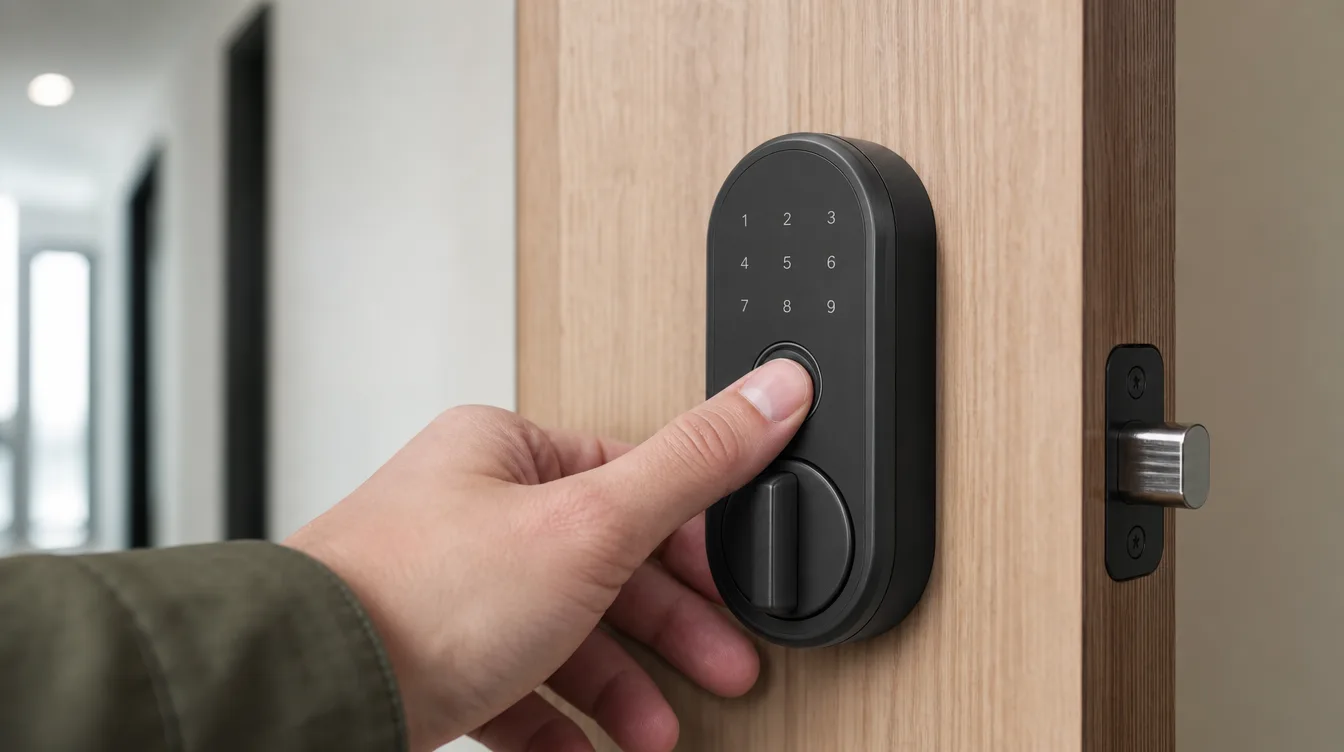
Wyze Lock Bolt Review (2026): Budget Fingerprint Entry, No Hub, No Fee
Bluetooth only, no hub
Fingerprint, keypad, app
Up to 50 stored
BHMA, UL 20-minute fire
Quick answer
The Wyze Lock Bolt is a Bluetooth-only deadbolt with a fingerprint reader that stores up to 50 prints, a backlit anti-peep keypad, and BHMA certification, running with no hub and no subscription. It suits buyers who want keyless entry at the lowest sensible cost and never need to touch the door from away. There is no remote access, no Wi-Fi upgrade path, and no physical keyway.
Pros
- Ultra-fast fingerprint reader stores up to 50 prints for the whole household
- Backlit anti-peep keypad hides a real code inside random digits
- Bluetooth-only design runs standalone with no hub, gateway, or subscription
- BHMA certified with a UL 20-minute fire rating and IPX5 weather resistance
Cons
- Bluetooth-only, so there is no remote lock, unlock, or notification
- No Wi-Fi and no gateway option to add remote access later
- No physical key; a fully dead battery relies on a USB-C jump charge
Best for
- Buyers who want fingerprint entry at the lowest possible cost
- Doors where local, at-the-lock control is enough and remote is not needed
- Households replacing a keyed deadbolt without wiring a hub or paying a fee
Spec comparison
| Spec comparison | Wyze Lock Bolt | Aqara Smart Lock U50 | August Wi-Fi Smart Lock |
|---|---|---|---|
| Connectivity | Bluetooth only, no Wi-Fi and no hub or gateway option | Bluetooth 5.0 and Zigbee 3.0, NFC; Aqara hub required for remote features and Matter | Built-in Wi-Fi (802.11 b/g/n, 2.4 or 5 GHz) plus Bluetooth, no bridge required |
| Entry methods | Fingerprint, backlit anti-peep keypad, app within Bluetooth range | Apple Home Key (iPhone or Apple Watch tap), keypad, NFC card, app, physical key | August app (iOS/Android), Apple Watch, existing physical key, optional keypad (sold separately), Alexa/Google Assistant/Siri voice, Auto-Unlock |
| Fingerprint | Ultra-fast reader, stores up to 50 fingerprints | — | — |
| Certification | BHMA certified, UL 20-minute fire rating, IPX5 weather resistance | BHMA Level 3, zinc alloy body, IPX5 weather resistance | Not ANSI/BHMA certified — mounts on an existing certified deadbolt (per August warranty page) |
| Power | 4 AA batteries, about 10 to 12 months, USB-C emergency jump charge | 4 AA batteries, up to 6 months, USB-C emergency power port | 2 CR123 batteries, included in the box |
| Codes capacity | Up to 20 access codes and 50 fingerprints; shareable with up to 50 people | Up to 75 passwords at once (ordinary plus temporary/periodic), 6–10 digits; up to 8 one-time passwords per hour | — |
| Key backup | No keyway (pick-proof by design); USB-C port for emergency power | Physical keys provided; USB-C port for emergency charging | Retrofit keeps the existing exterior cylinder — original keys still work |
| Door compatibility | Thru-hole 2-1/8 in; backset 2-3/8 or 2-3/4 in; door thickness 1-3/8 or 1-3/4 in | Most wooden doors 35–55 mm thick; supports all opening directions | — |
| Warranty | 1-year limited warranty | 12-month limited warranty (Aqara US) | 1-year limited hardware warranty |
| Door sensing | — | Built-in gyroscope detects door left open, auto-locks when closed | — |
| Installation | — | — | Retrofit over an existing single-cylinder deadbolt, interior side, under 10 minutes |
| Door status | — | — | DoorSense sensor reports whether the door is open or securely closed |
| Smart home | — | — | Works with Alexa, Google Assistant, and Siri; phone or Apple Watch acts as key |
| Dimensions | — | — | 72 mm diameter, 46 mm depth |
Methodology & sources
TestedThis review is backed by a validated long-term test record retained by Lena Carter.
Verified on August 8, 2026
Most of the smart locks on this site answer the subscription question by building Wi-Fi into the deadbolt so remote features cost nothing after the hardware. The Wyze Lock Bolt answers a different, narrower question: what is the cheapest honest way into real keyless entry? Its answer is to drop remote access entirely and spend the savings on the parts that touch a finger every day, a fast fingerprint reader and a backlit keypad, in a lock that runs standalone with no hub, no bridge, and no plan. For a household that just wants to stop carrying a key at the front or side door and does not need to open it from the office, that trade is the entire appeal, and it lands the Wyze Lock Bolt at the budget end of keyless entry.
This review reads the Lock Bolt against Wyze's published specifications and the way a Bluetooth-only lock actually lives on a door. Because this site exists to be honest about recurring costs, the no-fee, no-hub reality gets examined first, and then the one big thing this lock gives up, remote control, is stated as plainly as it deserves.
Fingerprint entry is what you are buying
The reason to pick the Lock Bolt over a plain keyed deadbolt is the fingerprint reader, and it is genuinely quick. Wyze rates it as an ultra-fast sensor, and in daily use a print opens the door in the moment it takes to reach for the handle, which is the difference between a lock that feels effortless and one you fight with while holding bags. The reader stores up to 50 fingerprints, so an entire household, and a few trusted regulars, can be enrolled, each print managed from the app.
Fingerprint is not the only way in. The Lock Bolt pairs the reader with a backlit keypad that carries an anti-peep feature: a real code can be padded with random digits before and after it, so a shoulder-surfer cannot read the PIN off finger movements, and the lock still opens on the genuine sequence hidden inside. The app manages up to 20 access codes, including one-time and scheduled codes that expire on their own, which covers a guest or a delivery window without handing out a permanent number.
The honest limit: Bluetooth only, no remote
This is the section that decides whether the Lock Bolt is the right lock for a given buyer, so it comes before the praise. The Lock Bolt is a Bluetooth-only device. It talks to a phone within Bluetooth range and nothing further: there is no built-in Wi-Fi, and, unlike some locks, there is no gateway or bridge accessory to add later. That means there is no locking or unlocking the door from across town, no push notification when a code is used while you are out, and no voice control through Alexa or Google Home. The app is essentially a local remote and a setup tool; step out of Bluetooth range and the lock keeps working perfectly on the door, but it drops off your phone.
For the right buyer that is not a flaw, it is the point. A lock that never reaches the internet is a lock that cannot be attacked over the internet, and the fingerprint and keypad, the things actually used every day, do not need a network to work. But it has to be said clearly, because it is the opposite of how the ULTRALOQ U-Bolt Pro and the Schlage Encode on this site behave: those build in Wi-Fi so you can check and control the door from anywhere. Anyone who wants remote access should not buy the Lock Bolt expecting to add it, because the hardware simply does not offer it.
What the Ultraloq does that the Wyze does not
Set beside the ULTRALOQ U-Bolt Pro, the step-up fingerprint lock reviewed here, the gaps are exactly the ones the lower cost pays for. The Ultraloq builds in Wi-Fi for true remote control with no hub, so its fingerprint entry is joined by locking and alerts from anywhere; the Lock Bolt keeps its intelligence at the door. The Ultraloq includes a real door sensor, so its auto-lock fires only once the door is actually shut, while the Lock Bolt's auto-lock is a timer that throws the bolt a set delay after unlocking, closed door or not. The Ultraloq is certified to ANSI Grade 1, the commercial tier; Wyze states the Lock Bolt is built to resist kicking and prying like a traditional deadbolt and backs it with a BHMA certification and a UL-listed 20-minute fire rating, but it does not claim the Grade 1 mark. None of that makes the Lock Bolt a bad lock. It makes it the lock you choose when biometric entry matters and the extras do not justify the higher spend.
No key, and how the fallbacks work
One design decision deserves its own note: the Lock Bolt has no physical keyway. That keeps the exterior clean and removes the lock-picking surface a cylinder presents, but it changes what happens when the batteries die. In place of a key, the four AA cells are rated at roughly 10 to 12 months and warn in the app long before they fail, and a USB-C port on the underside of the keypad accepts a power bank to deliver an instant jump charge, enough to wake the keypad and enter a code. The app can also issue time-limited one-time codes, up to a set number in a rolling window, for a guest who needs in without a fingerprint on file. The absence of a key is a reasonable trade for most buyers, but anyone who wants the reassurance of a metal key in a pocket should weigh it, because there is no traditional keyed override here.
Storage, privacy, and the subscription question
The Lock Bolt fits a no-fee philosophy almost by default: because there is no cloud service behind it, there is no subscription to sell. Fingerprints and codes are stored and encrypted on the lock, the access history lives in the app over Bluetooth, and Wyze states the credentials are encrypted so that they cannot be read back, including by Wyze. There is no recurring charge because there is no ongoing service, which is the purest version of the promise this site is built around, arrived at by leaving the internet out entirely rather than by making cloud features free.
The flip side is the same limitation named above rather than a privacy asterisk: with nothing leaving the door, there is also nothing to view remotely. For a buyer who counts a lock that never phones home as a privacy win, the Lock Bolt is close to ideal; for one who wants alerts and remote control, it is the wrong category.
Who should buy it
The Lock Bolt is the right lock for a buyer who wants fast, reliable fingerprint entry at the lowest sensible cost and does not need to touch the door from away. It suits a household tired of hiding a spare key, a busy family that wants each member enrolled by fingerprint, and anyone extending keyless entry to a second door where remote control would be a luxury rather than a need. It pairs naturally with a Wyze Cam v3 for a household already inside the Wyze app.
Who should skip it
Anyone who wants to lock, unlock, or check the door remotely should skip it, because the Bluetooth-only hardware cannot be upgraded to do that. Alexa and Google Home households that expect voice control will not find it here. Renters who cannot replace the deadbolt should choose a retrofit lock instead, and a buyer who insists on a physical key fallback should look at a keyed model rather than rely on the USB-C jump charge.
How it compares
Against the ULTRALOQ U-Bolt Pro, the Lock Bolt gives up built-in Wi-Fi, a real door sensor, and a Grade 1 certification, and wins on outright affordability for the same core fingerprint experience. Against the Schlage Encode, the split is even starker: the Encode is a Wi-Fi, Grade 1, remotely controlled deadbolt with a keypad, while the Lock Bolt is a local, biometric, budget lock with none of the remote layer. And within the Wyze family, the Lock Bolt is the deliberately simpler sibling to the Wi-Fi Wyze Lock, trading remote reach for a lower cost and a fingerprint reader. It is the pick for a buyer whose priority is keyless entry that just works, without a hub on the shopping list or a fee on the calendar.
Verdict
The Wyze Lock Bolt does one job and does it cheaply and well: it replaces a key with a fast fingerprint and a backlit anti-peep keypad, stores everything on the lock, and never asks for a hub or a subscription because it never touches the internet. The costs are real and worth repeating, no remote control of any kind, no gateway to add it, and no physical key, only a USB-C jump charge as a backstop. For the buyer who wants biometric entry at the budget end and genuinely does not need to open the door from away, the Lock Bolt is one of the most honest low-cost locks on the market. It promises less than the Wi-Fi locks around it, and it charges accordingly.
Frequently asked questions
Can the Wyze Lock Bolt be unlocked remotely?
No. The Lock Bolt is a Bluetooth-only lock with no built-in Wi-Fi and no gateway or bridge accessory to add one, so it cannot be locked, unlocked, or checked from outside Bluetooth range. The fingerprint reader, keypad, and app all work at the door; there is simply no over-the-internet remote layer, by design.
Is there a monthly fee?
No. Because the Lock Bolt has no cloud service behind it, there is nothing to subscribe to. Fingerprints and codes are stored and encrypted on the lock, and the access history lives in the free Wyze app over Bluetooth, with every feature included at no recurring cost.
What happens if the batteries die and there is no key?
The Lock Bolt has no physical keyway. The four AA batteries last roughly 10 to 12 months and warn in the app first, and if they do run flat, a USB-C port under the keypad takes a power bank to deliver an instant jump charge, enough to wake the keypad and enter a code to get in.
How many fingerprints and codes can it hold?
The reader stores up to 50 fingerprints, enough for a whole household and a few trusted regulars, and the app manages up to 20 access codes, including one-time and scheduled codes that expire on their own for guests and deliveries.
Editorial summary
The Wyze Lock Bolt is a Bluetooth-only fingerprint deadbolt with a backlit anti-peep keypad and on-lock storage, so keyless entry needs no hub and no fee.
Where to buy
Check the merchant for the current price and availability. We may earn a commission.