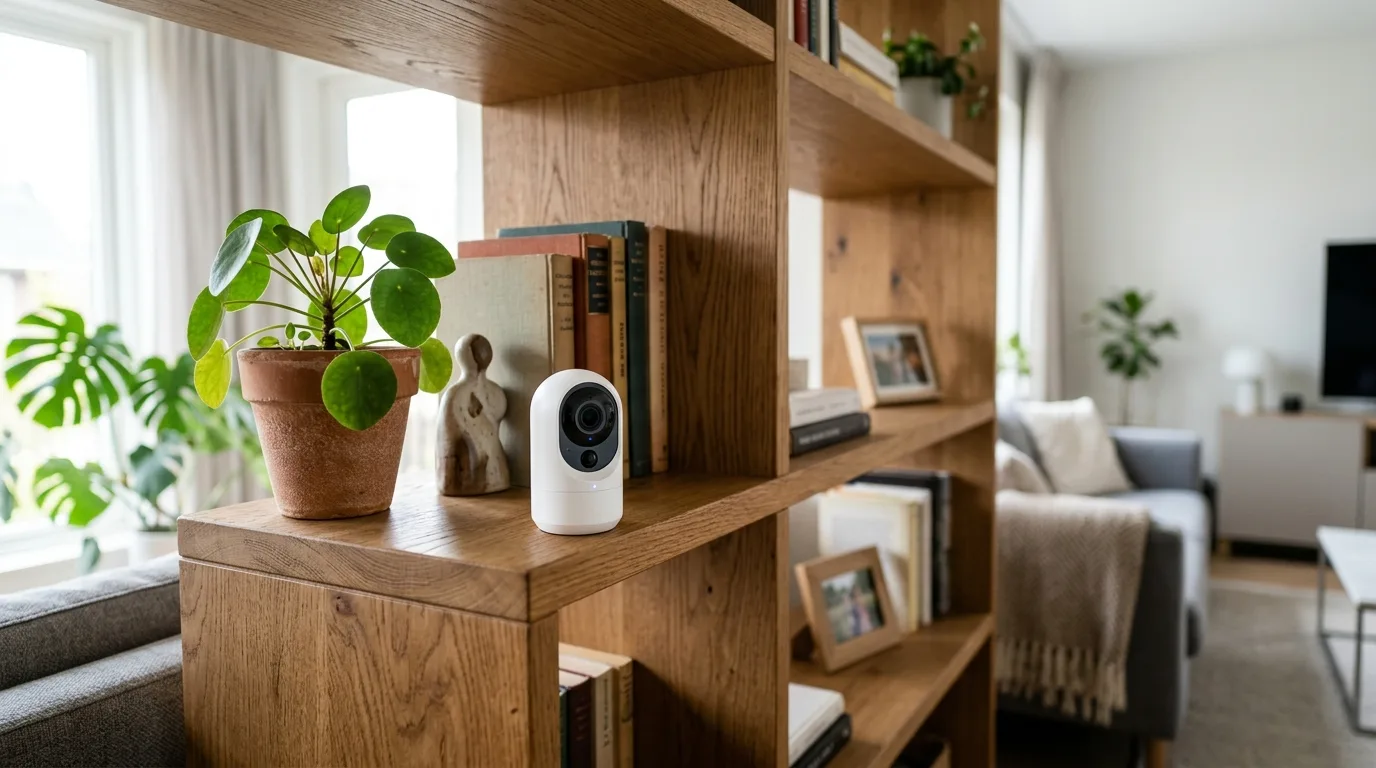
Ring Indoor Cam (2nd Gen) Review: A Budget Camera With a Real Privacy Switch
1080p HD
143° diagonal
Color night vision
Plug-in (1.9 m micro-USB)
Pros
- Manual privacy cover physically disables camera and microphone
- Sharp 1080p video with color night vision
- Live view, two-way talk, and alerts work with no subscription
- Compact plug-in design with swivel mount installs in minutes
Cons
- Recorded video history requires a paid Ring Home subscription
- No local storage option at all
- 2.4 GHz Wi-Fi only and indoor use only
Best for
- Households already inside the Ring and Alexa ecosystem
- Buyers wanting a simple plug-in indoor camera
- Pet owners checking in during the day
- Privacy-conscious users who want a physical shutter
Spec comparison
| Spec comparison | Ring Indoor Cam (2nd Gen) | Amcrest IP5M-T1179EW | Arlo Pro 5S 2K |
|---|---|---|---|
| Resolution | 1080p HD | 5MP (2592×1944), 1/2.7-inch CMOS | 2K HDR |
| Field of view | 143° diagonal | 132° super-wide | 160° |
| Night vision | Color night vision | Infrared LEDs, up to 98 ft (30 m) | — |
| Power | Plug-in (1.9 m micro-USB) | Power over Ethernet, requires a PoE switch or injector (not included) | Rechargeable swappable battery |
| Privacy | Manual privacy cover | — | — |
| Storage | Cloud recording with a Ring subscription; motion event videos saved up to 180 days (default 30 days); 24/7 recording available with Ring Home | microSD up to 256GB, Amcrest NVR, NAS, FTP or PC, no fee required | Cloud recording with an Arlo Secure plan (trial included); local storage with compatible SmartHub/Base Station (VMB4000, VMB4500, VMB4540, VMB5000) |
| Connectivity | 802.11 b/g/n Wi-Fi (2.4 GHz); minimum 2 Mbps upload recommended | Wired PoE (single Ethernet cable carries power and data); works with Amcrest Surveillance Pro, Blue Iris and mainstream browsers | Dual-band Wi-Fi |
| Subscription | Required | Not required | Required |
| Warranty | One-year limited warranty, including theft protection | 1-year replacement warranty with 30-day money-back guarantee (Amcrest US) | Limited hardware warranty, generally one year from date of purchase |
| Dimensions | 4.9 × 4.9 × 9.6 cm (1.93 × 1.93 × 3.81 in), including mount | 3.7 × 3.7 × 3.2 in, 1.04 lbs | 3.5 × 2.0 × 3.0 in (89 × 52 × 78.4 mm) |
| Weatherproofing | — | IP67 | — |
| Night Vision | — | — | Color (integrated spotlight) |
| Weather rating | — | — | Weather-resistant, operating temperature -4°F to 113°F (-20°C to 45°C) |
Methodology & sources
TestedThis review is backed by a validated long-term test record retained by Lena Carter.
Verified on August 8, 2026
The Ring Indoor Cam (2nd Gen) is the smallest and least expensive camera Ring sells, and it makes a stronger case for itself than its budget-tier positioning suggests. It is a compact plug-in camera for indoor use that captures 1080p HD video, sees in color at night, carries a two-way intercom, and ships with something almost no rival at this level offers: a physical privacy cover that switches the camera and microphone off with a swivel. Paired with a Ring doorbell, it extends a front-door setup into a whole-home one for a modest extra outlay.
The catch is the same one that hangs over every Ring device, and it deserves to be stated up front. Live viewing and real-time alerts cost nothing, but recorded video history requires a paid Ring Home subscription, and this camera has no local storage to fall back on. The assessment below reads the Indoor Cam (2nd Gen) against Ring's published specifications and subscription terms, with that trade-off treated as a central part of the buying decision rather than a footnote.
A privacy cover that actually works
The headline feature of this second-generation model is the removable manual privacy cover mounted on the body. Sliding it in front of the lens disables both the camera and the microphone outright, with no settings menu to find and no software toggle to trust. Swiveling the cover aside turns the camera back on, and it can be removed entirely for total certainty at any hour. If there is ever doubt about which state the camera was left in, the Ring app reports the camera's status at any time, according to Ring's own documentation.
Software privacy controls back up the hardware. Privacy zones drawn in the app black out regions that should never be viewed or recorded, such as a bathroom doorway or a workspace, and motion detection and audio recording can be switched off independently. For a camera that lives inside the home, pointed at the rooms people actually occupy, that combination of a physical shutter and configurable zones is the strongest privacy story in the budget indoor camera tier.
Image quality: 1080p, day and night
The camera records in 1080p HD with Live View on demand. The field of view is 143 degrees on the diagonal, 115 degrees horizontally, and 59 degrees vertically, which is wide enough to take in most of a room from a corner shelf or the top of a bookcase. The market is drifting toward 2K and 4K sensors, but indoor cameras work at short distances, and a well-implemented 1080p image at three to five meters carries enough detail to recognize a face or read what a pet knocked off the counter.
After dark, the camera falls back on color night vision rather than rendering everything in flat monochrome, which keeps usable detail in scenes that retain a little ambient light from a hallway or a streetlamp through a window. For an indoor camera whose main job is checking on a living room, a nursery door, or a garage interior, that nighttime performance matches the assignment.
Motion detection and alerts
When the camera detects motion, it sends a real-time notification to a phone or tablet. Customizable motion zones define where in the frame the camera should pay attention, which matters indoors more than it sounds: a camera that covers both a doorway and a sunlit window will otherwise alert every time the light shifts. Advanced Pre-Roll captures the seconds leading up to a trigger, so a recorded event shows how it started rather than opening halfway through the action.
Smarter filtering sits one level up. Person alerts, which use what Ring calls Ring IQ to recognize people and notify only when one is spotted, are part of the Ring Home subscription rather than the free feature set, per Ring's published feature list.
Two-way talk and Alexa
Audio is handled by a two-way talk system with background noise cancellation, clear enough for a real exchange rather than a walkie-talkie garble. The obvious indoor uses are the everyday ones: telling a dog to get off the sofa, asking a family member a question from another room, or speaking to someone in the garage without walking over.
The camera also works with Alexa, which is the payoff of buying inside Amazon's ecosystem. A voice request to an Echo Show pulls the live feed onto the screen, turning any smart display in the house into a room monitor, and the camera folds naturally into Alexa routines alongside other connected devices.
Design, power, and setup
Physically, the Indoor Cam (2nd Gen) is small even by mini-camera standards, measuring 4.9 by 4.9 by 9.6 cm including the swivel mount and camera bracket, and it comes in a choice of finishes, White, Black, Starlight, Charcoal, or Blush, per Ring's product page. The flexible swivel mount allows placement on a flat surface or installation higher up on a wall or ceiling beam, and the box includes the mounting hardware.
Power comes from a 1.9 m micro-USB cable and AC adapter, with a longer 3 m cable sold separately for awkward outlet positions. This is an indoor-only camera, rated to operate from minus 20 to 45 degrees Celsius, and it connects over 2.4 GHz 802.11 b/g/n Wi-Fi with a minimum 2 Mbps upload speed recommended for best performance. There is no 5 GHz support. Ring quotes an average setup time of five to ten minutes: plug in, pair through the app, aim the mount, done.
The Ring Home subscription, stated plainly
Here is the part a no-monthly-fees site has to say clearly. Without a Ring Home subscription, the Indoor Cam still does a real set of things: it streams live video on demand, it supports two-way talk, it sends real-time motion notifications, and the Ring dashboard shows the latest captured snapshot from active devices. As a live check-in camera, it functions with no plan at all.
What a subscription-free camera cannot do is save anything. Miss a notification, open the app five minutes late, and there is no recorded clip to review, because the device has no local storage of any kind. Recording, sharing, and reviewing events for up to 180 days, person alerts, and device Modes all require an active Ring Home plan, and continuous 24/7 recording on eligible devices, kept for up to 14 days, sits behind Ring Home Premium, per Ring's documentation. In plain terms: the hardware is capable, but the memory is rented.
Ownership terms are otherwise solid. Ring backs the camera with a one-year limited warranty that includes theft protection, and the company guarantees software security updates for at least four years after the device is last sold as new on its websites.
Where it fits in a Ring household
Few people buy an indoor camera in isolation, and this one is at its strongest as a node in an existing Ring setup. A single app and a single account tie it to a Ring Battery Doorbell or Ring Wired Doorbell at the front of the house, so a doorbell press and indoor motion surface in one timeline instead of separate apps. The subscription math also softens with scale: a Ring Home plan covers every eligible Ring device on the account at once, so a household already paying for a doorbell adds this camera to a plan it already holds rather than starting a new one. For a first-time Ring buyer, that math looks different and is worth running before committing.
How it compares
Against the Wyze Cam v3, the contrast is philosophical. The Wyze records 24/7 to a microSD card with no subscription and carries an IP65 weather rating for indoor or outdoor use, which directly answers the recording complaint above, but it lives in its own app ecosystem and offers no privacy shutter. Against the Blink Outdoor 4, the choice is about placement and power: the Blink is battery-powered and built for outdoor duty, while the Indoor Cam is a plug-in device for interior rooms, so the decision follows the location rather than the brand. Against a Ring Battery Doorbell, this camera is a complement rather than a rival: the doorbell watches the front step, the Indoor Cam watches the room behind it, and both land under the same plan.
Who should buy it
The Indoor Cam (2nd Gen) is the right pick for households already inside the Ring and Alexa world, where one app, one timeline, and one subscription cover everything. It suits buyers who want the simplest possible plug-in indoor camera, pet owners who want a quick daytime check-in with two-way audio, and anyone who values a physical privacy shutter over promises in a settings menu.
Who should skip it
Anyone determined to avoid subscriptions should skip it, because recorded history is gated behind Ring Home with no local fallback, and a camera with onboard or hub-based storage is the honest alternative. It is also the wrong tool for outdoor or battery-powered placement, for households that insist on 5 GHz Wi-Fi, and for buyers who want a motorized pan-and-tilt lens to track movement around a large space, since this is a fixed camera.
Verdict
The Ring Indoor Cam (2nd Gen) is a small camera with one big idea: the manual privacy cover makes off genuinely mean off, and that single feature sets it apart in the budget indoor tier. The 1080p image is sharp enough for indoor distances, color night vision covers the dark hours, and setup is measured in minutes. The reservation is unchanged from every Ring review on this site and unavoidable: recorded video, the thing most buyers ultimately want, requires a Ring Home subscription with no local option to escape it. For a Ring or Alexa household happy to live inside that plan, this is the easiest and least expensive camera to add. For anyone who reads a monthly fee as a dealbreaker, a local-storage rival is the better purchase.
Editorial summary
Editorial overview of the Ring Indoor Cam (2nd Gen) based on published manufacturer specifications, support policies, and public guidance.
Subscription math
Ring Indoor Cam (2nd Gen) · $4.99 per month
| Period | Device only | Device + subscription |
|---|---|---|
| 1 year | $49.99 | $109.87 |
| 3 years | $49.99 | $229.63 |
| 5 years | $49.99 | $349.39 |
Where to buy
Check the merchant for the current price and availability. We may earn a commission.