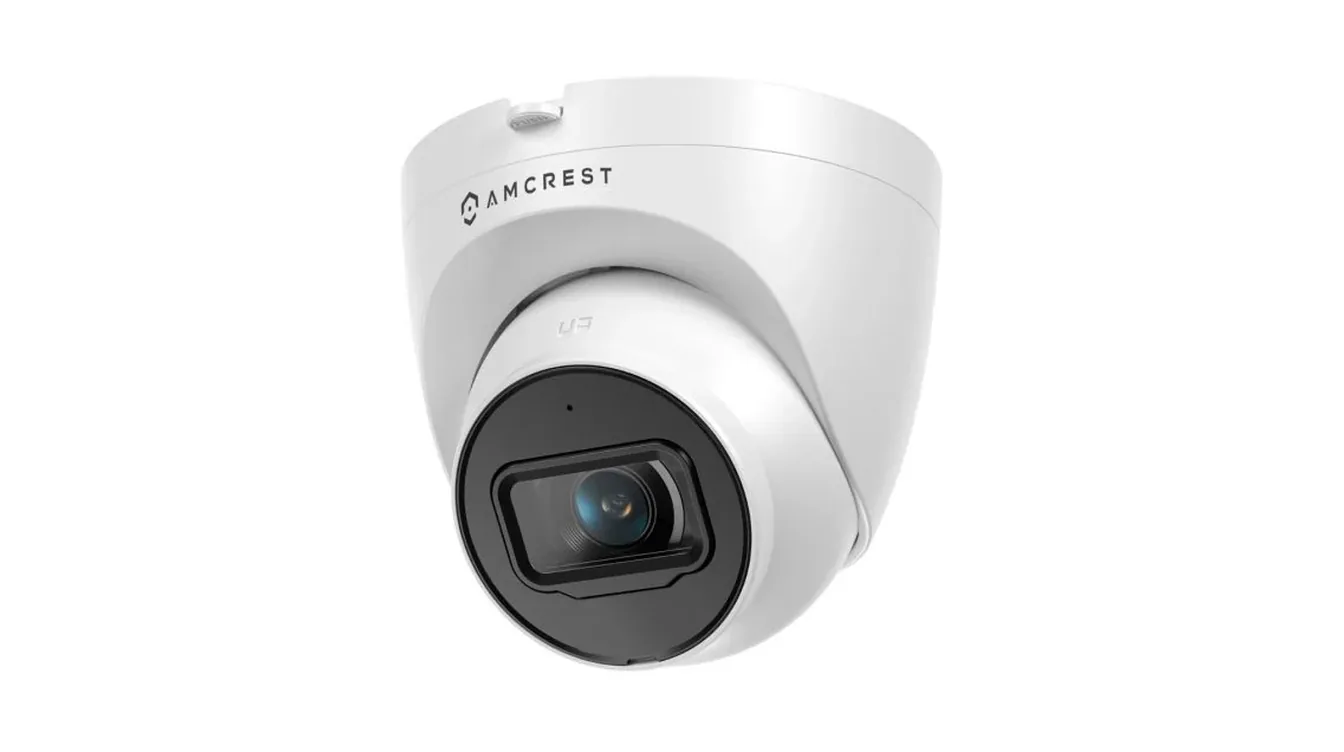
Amcrest IP5M-T1179EW Review (2026): 5MP PoE Turret, Storage You Own
5MP (2592×1944)
PoE, single cable
microSD 256GB, NVR, NAS or PC
Infrared, up to 98 ft
Quick answer
The Amcrest IP5M-T1179EW is a 5MP Power-over-Ethernet turret camera with a 132-degree field of view that records to a microSD card, an NVR, or a NAS, with no monthly fee. It suits owners who can run a single Ethernet cable to the mount and want storage they own. A PoE injector or switch is required and not included, and night vision is infrared monochrome.
Pros
- 5MP resolution and a 132° super-wide view over one PoE cable
- Records to microSD, an NVR, a NAS, FTP, or a PC with no monthly fee
- IP67 housing with infrared night vision rated to 98 ft
- Works with Amcrest Surveillance Pro, Blue Iris, and standard browsers
Cons
- Requires a PoE switch or injector, and none is included in the box
- A microSD card or other storage is a separate purchase
- Infrared night vision is black and white, not color
- Fixed lens with no pan or tilt, and one-way audio only
Best for
- Buyers who want a wired camera that records to storage they own
- Homes that can run a single Ethernet cable to the mounting point
- Owners who want one wide-angle camera to cover a yard or driveway
Spec comparison
| Spec comparison | Amcrest IP5M-T1179EW | Arlo Pro 5S 2K | Blink Outdoor 4 |
|---|---|---|---|
| Resolution | 5MP (2592×1944), 1/2.7-inch CMOS | 2K HDR | 1080p HD |
| Field of view | 132° super-wide | 160° | 143° |
| Night vision | Infrared LEDs, up to 98 ft (30 m) | — | — |
| Storage | microSD up to 256GB, Amcrest NVR, NAS, FTP or PC, no fee required | Cloud recording with an Arlo Secure plan (trial included); local storage with compatible SmartHub/Base Station (VMB4000, VMB4500, VMB4540, VMB5000) | Local (Sync Module XR/2) or Blink cloud |
| Power | Power over Ethernet, requires a PoE switch or injector (not included) | Rechargeable swappable battery | AA lithium, up to 2-year life |
| Weatherproofing | IP67 | — | — |
| Connectivity | Wired PoE (single Ethernet cable carries power and data); works with Amcrest Surveillance Pro, Blue Iris and mainstream browsers | Dual-band Wi-Fi | 2.4 GHz 802.11b/g/n Wi-Fi (requires Sync Module) |
| Subscription | Not required | Required | Not required |
| Warranty | 1-year replacement warranty with 30-day money-back guarantee (Amcrest US) | Limited hardware warranty, generally one year from date of purchase | One-year limited warranty |
| Dimensions | 3.7 × 3.7 × 3.2 in, 1.04 lbs | 3.5 × 2.0 × 3.0 in (89 × 52 × 78.4 mm) | 2.76 × 2.76 × 1.61 in (70 × 70 × 41 mm) |
| Night Vision | — | Color (integrated spotlight) | Infrared |
| Weather rating | — | Weather-resistant, operating temperature -4°F to 113°F (-20°C to 45°C) | IP65 weather-resistant |
Methodology & sources
TestedThis review is backed by a validated long-term test record retained by Lena Carter.
Verified on August 8, 2026
The no-subscription cameras on this site all solve the same problem from a different angle: how to keep footage without renting cloud space by the month. The Amcrest IP5M-T1179EW solves it the installer's way, with a wire. It is a 5-megapixel Power-over-Ethernet turret camera that draws power and sends video down a single cable, then writes the footage to storage the owner already controls. Amcrest's optional cloud service exists for off-site backup, but nothing about recording, viewing, or playback requires it.
This review reads the IP5M-T1179EW against Amcrest's published specifications and the way a wired PoE camera actually behaves in a home installation. The current listing is the AI-V3 revision of a long-running model, and the no-monthly-fee claim is examined first, then weighed against what this camera asks of the person installing it.
5MP over a single cable
The IP5M-T1179EW captures 5-megapixel video at 2592 by 1944 through a 1/2.7-inch CMOS sensor. That sits between ordinary 1080p and true 4K: sharper than the budget plug-in cameras, short of the detail a 4K sensor returns when a frame is zoomed to read a plate across the street. For a driveway, a gate, or a back yard, it is a sensible middle that keeps file sizes and network load lower than 4K.
The headline number is the 132-degree super-wide viewing angle. One turret in a corner can take in most of a yard that a narrower bullet camera would see only in slices. The trade is baked into the physics: spread the same pixels across a wider scene and each distant object gets fewer of them, so this is a camera for covering an area rather than identifying a face at the far end of it.
Delivery is Power over Ethernet, so one Cat5e or Cat6 run carries both electricity and data. There is no power adapter at the mounting point and no Wi-Fi radio competing for bandwidth, and the camera never asks to be recharged. The catch, stated plainly on Amcrest's own product page, is that a PoE injector or switch is required and not included; the camera ships without any power supply, so a buyer without PoE equipment should budget for an injector alongside it.
Storage you already own
This is where the IP5M-T1179EW earns its place in a no-subscription lineup. It records to a microSD card up to 256GB in the camera itself, to Amcrest's NVRs for multi-camera setups, to a Synology or QNAP NAS, over FTP, or to a PC running the included Amcrest Surveillance Pro software. Third-party software such as Blue Iris works too. Dual H.265 and H.264 compression keeps recordings compact while staying compatible with older platforms.
Every one of those routes keeps the footage on hardware in the home, and none carries a monthly fee. Set that against cameras whose saved history sits in the cloud, billed every month for as long as the camera stays on the wall. The honest qualification is that local recording is not free out of the box in the literal sense: a microSD card or another storage target is a separate purchase, worth planning for alongside the camera.
Night vision and the turret design
After dark the camera relies on built-in infrared LEDs, rated by Amcrest to reach up to 98 feet, paired with the CMOS sensor's low-light performance. That comfortably covers a yard in total darkness. The honest limit is that infrared means black and white: the nighttime image describes shapes and movement in monochrome, and buyers who specifically want color night vision will need a starlight or spotlight model instead.
The turret form factor earns a word on its own. Unlike a bullet camera, the ball-and-socket turret can be aimed freely after mounting, and because the lens sits apart from the LED ring, the design avoids the infrared bounce-back that fogs bullet footage when dust or a spider web crosses the housing. The housing is IP67-rated against dust and rain. A built-in microphone adds one-way audio, so recordings carry the sound of the scene, but there is no speaker to talk back through.
Software, alerts, and one disclosure
Motion alerts arrive through the Amcrest View app, and footage can be reviewed there or played back through the desktop software. Because detection and recording happen at the camera and on local storage, none of the core functions sit behind a plan; Amcrest Cloud remains a strictly optional add-on.
One disclosure deserves attention rather than a footnote. Amcrest states that this product may contain components that are not NDAA compliant. For a private home that changes little, but buyers purchasing for government, contractor, or compliance-sensitive sites should treat it as a deciding fact.
Installation: the PoE reality
A wired camera asks more of its installer than a battery unit does. Someone has to run an Ethernet cable from a PoE switch or injector to the mounting point, which usually means drilling an exterior wall, fishing a run through an attic or soffit, and terminating a connector. For a homeowner comfortable with that, it is an afternoon's work, and the reward is a camera that never needs charging and never drops off Wi-Fi. For a renter, it is a non-starter.
The camera is also fixed, with no pan or tilt mechanism. Aiming is done physically at the mount, so the wide 132-degree view matters twice over: once for coverage, and again because the frame chosen on installation day is the frame the camera keeps.
Who should buy it
The IP5M-T1179EW suits a homeowner who wants subscription-free, always-powered coverage of a fixed area and is willing to run one cable to get it. It fits buyers who want the widest view from a single mounting point, who value choosing between a microSD card, an NVR, a NAS, or a PC for recording, and who are comfortable adding a PoE injector and a card to the order.
Who should skip it
Renters and anyone who cannot run Ethernet should skip it and choose a wireless camera instead. Buyers who want color night vision, pan-and-tilt tracking, or two-way talk should look elsewhere, because this camera offers none of the three. And anyone purchasing for an NDAA-regulated site should take Amcrest's own disclosure as the answer and pick a compliant model.
How it compares
Against the Reolink RLC-810A reviewed here, the split is detail versus width: the Reolink's 4K sensor resolves more at distance but sees a narrower 87-degree slice, while the Amcrest covers far more of the scene from one mount at 5MP, and both record locally over a single PoE cable. Against the Lorex 4K Spotlight, the Lorex is the plug-in Wi-Fi choice with color night vision and a card in the box, whereas the Amcrest trades those conveniences for a wired link and broader storage options. And against the budget TP-Link Tapo C120, the Tapo is the cheaper plug-in pick for a windowsill, while the Amcrest is the step up for a permanent outdoor mount fed by a cable. The pillar's local-storage story runs through this camera: it is the wide-angle wired pick.
Verdict
The Amcrest IP5M-T1179EW is a straightforward, own-it-outright PoE camera. The 5MP sensor and 132-degree view cover a large area from a single mount, the turret design aims easily and resists infrared bounce-back, and the storage story is as open as this category gets: microSD, NVR, NAS, FTP, or PC, with no fee attached to any of them. The compromises are exactly what a wired camera implies: no power supply in the box, storage bought separately, infrared black-and-white night vision, a fixed lens with one-way audio, and an NDAA disclosure that rules it out for compliance-sensitive buyers. For a homeowner who wants wide, wired, locally stored coverage and accepts those terms, it does the job without a monthly bill.
Frequently asked questions
Does the Amcrest IP5M-T1179EW need a subscription?
No. The camera records to a microSD card, an NVR, a NAS, FTP, or a PC, and viewing and playback work with no monthly plan. Amcrest Cloud exists as an optional off-site backup, but every core function runs without it.
What do you need to power it?
Power over Ethernet, which means a single network cable from a PoE switch or a PoE injector. Neither is included in the box, and there is no separate power supply, so buyers without PoE equipment should add an injector to the order.
Can it record to a NAS or a computer?
Yes. Alongside a microSD card up to 256GB, the camera records to Amcrest NVRs, Synology and QNAP NAS devices, FTP servers, and PCs running the included Amcrest Surveillance Pro software, and it works with third-party software such as Blue Iris.
Does it have color night vision or two-way audio?
Neither. Night vision is infrared, rated up to 98 feet, and the nighttime image is black and white. The built-in microphone provides one-way audio only, so the camera can record sound from the scene but cannot speak back.
Editorial summary
The Amcrest IP5M-T1179EW is a 5MP PoE turret camera that records to a microSD card, NVR, or NAS you own, so footage stays at home with no monthly fee.