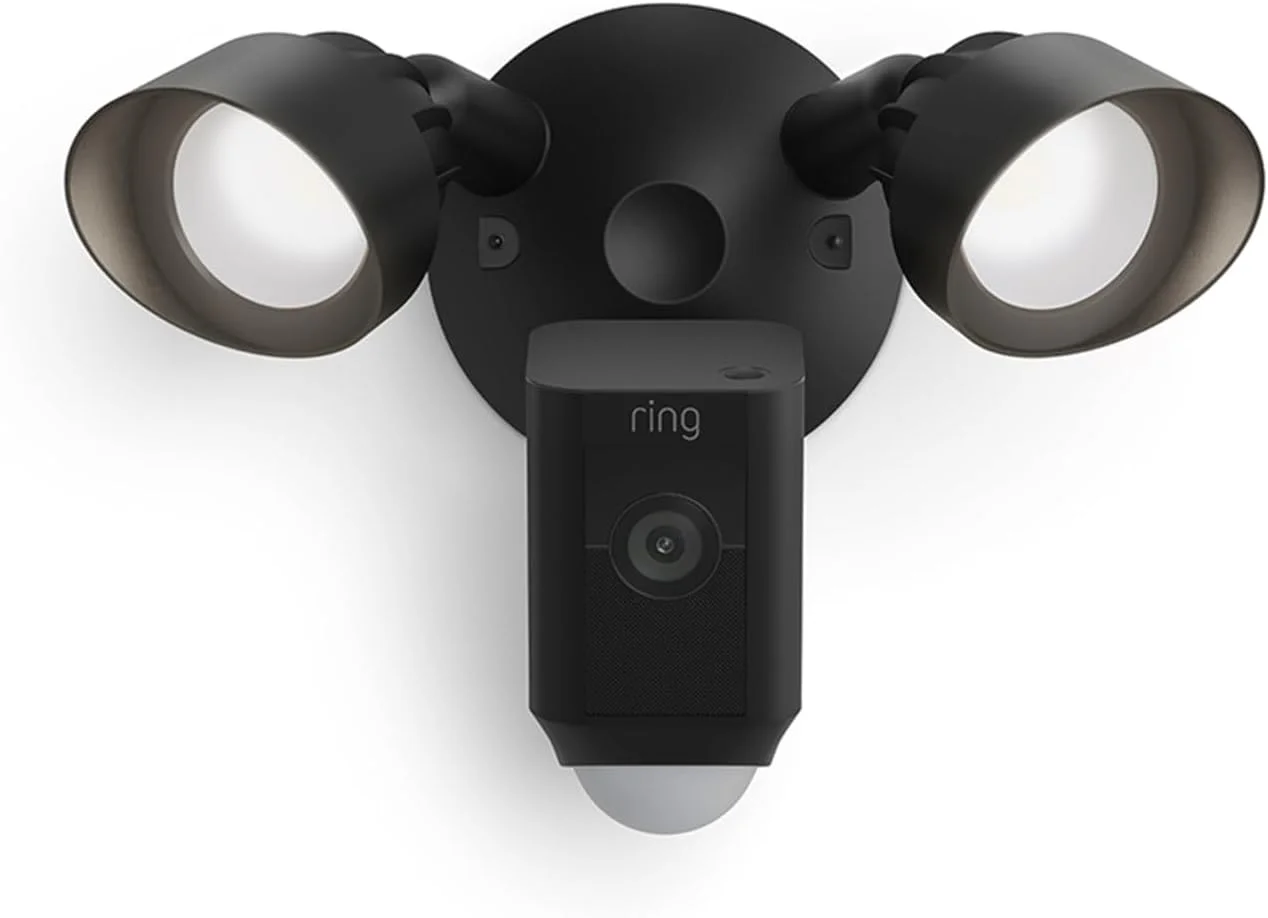
Ring Floodlight Cam Wired Plus Review (2026): 2,000 Lumens, Wired Power
1080p HD, Color Night Vision
140° horizontal, 80° vertical
Two LEDs, 2,000 lumens, 3,000K
105 dB, remote-activated
Quick answer
The Ring Floodlight Cam Wired Plus replaces a wired exterior floodlight, pairing two 2,000-lumen LED panels with a 1080p camera, a 105 dB siren, and hardwired power with no batteries to charge. It suits homeowners with an existing junction box, especially Alexa households. Recording and playback require a Ring Protect subscription, and there is no local storage option.
Pros
- Two 2,000-lumen floodlights turn the fixture into active deterrence, not just a witness
- Hardwired 100–240V power, so no batteries to charge and no solar dependence
- Remote-activated 105 dB siren and two-way audio with noise cancellation
- Dual-band Wi-Fi and deep Alexa integration across Echo and Fire TV devices
Cons
- Video tops out at 1080p where newer rivals now shoot 2K, 3K, or 4K
- Recording and playback require a Ring Protect subscription, with no local storage option
- Fixed camera position, so coverage is one direction inside the 140-degree field of view
- Hardwired junction-box installation is electrical work, not a quick mount
Best for
- Homeowners replacing a wired floodlight who want a camera built into the fixture
- Driveways, garages, and backyards that need light and recording from one mount
- Alexa households that want announcements and live view on Echo and Fire TV devices
Spec comparison
| Spec comparison | Ring Floodlight Cam Wired Plus | Amcrest IP5M-T1179EW | Arlo Pro 5S 2K |
|---|---|---|---|
| Resolution | 1080p HD video with Color Night Vision and Live View | 5MP (2592×1944), 1/2.7-inch CMOS | 2K HDR |
| Field of View | 140° horizontal, 80° vertical | — | — |
| Lights | Two motion-activated LED floodlights, 2,000 lumens, 3,000K | — | — |
| Siren | Remote-activated 105 dB siren | — | — |
| Power | Hardwired 100–240V AC, mounts on a 4-inch round weatherproof electrical box | Power over Ethernet, requires a PoE switch or injector (not included) | Rechargeable swappable battery |
| Connectivity | Dual-band Wi-Fi 802.11 a/b/g/n/ac (2.4/5 GHz) | Wired PoE (single Ethernet cable carries power and data); works with Amcrest Surveillance Pro, Blue Iris and mainstream browsers | Dual-band Wi-Fi |
| Night vision | Color night vision with HDR | Infrared LEDs, up to 98 ft (30 m) | — |
| Storage | Cloud recording with a Ring Home subscription; motion event videos saved up to 180 days, photos up to 7 days | microSD up to 256GB, Amcrest NVR, NAS, FTP or PC, no fee required | Cloud recording with an Arlo Secure plan (trial included); local storage with compatible SmartHub/Base Station (VMB4000, VMB4500, VMB4540, VMB5000) |
| Weather rating | Weather resistant, -20°C to 50°C | — | Weather-resistant, operating temperature -4°F to 113°F (-20°C to 45°C) |
| Subscription | Required | Not required | Required |
| Warranty | One-year limited warranty, including theft protection | 1-year replacement warranty with 30-day money-back guarantee (Amcrest US) | Limited hardware warranty, generally one year from date of purchase |
| Dimensions | 24.6 × 29.9 × 17.9 cm | 3.7 × 3.7 × 3.2 in, 1.04 lbs | 3.5 × 2.0 × 3.0 in (89 × 52 × 78.4 mm) |
| Field of view | — | 132° super-wide | 160° |
| Weatherproofing | — | IP67 | — |
| Night Vision | — | — | Color (integrated spotlight) |
Methodology & sources
TestedThis review is backed by a validated long-term test record retained by Lena Carter.
Verified on August 8, 2026
A floodlight camera makes a different promise than a battery camera. It replaces an exterior light fixture outright, draws continuous power from the home's wiring, and pairs a camera with illumination bright enough to change behavior. The Ring Floodlight Cam Wired Plus is the mainstream expression of that idea: two LED floodlight panels, a 1080p camera between them, a siren, and the Ring app tying it together. It is also one of the longest-running designs in the category, which cuts both ways — the formula is proven, but the video specification has stood still while rivals moved to 2K and beyond.
This review reads the camera against Ring's published specifications: the light first, because the light is the point, then the video, the motion system, the subscription-gated recording model, and the wiring job stated plainly.
A floodlight first, and it shows
Per Ring's spec sheet, the fixture carries two LED panels rated at 2,000 lumens with a 3,000 Kelvin warm-white color temperature, triggered by the camera's motion detection. Two thousand lumens is genuine floodlight territory, enough to wash a driveway rather than paint a token spotlight circle, and 3,000K sits closer to a traditional porch light than the blue-white of cheaper LEDs. Panels and camera adjust on the mounting base, so the beams can be aimed at the walk-up path while the lens holds a slightly different line. Ring's documentation also describes manual light control from the app, so the fixture doubles as a normal exterior light when needed. As deterrence the logic is sound: a person approaching a lit house behaves differently than one approaching a dark house, and the camera records whatever the light reveals.
Video quality: competent 1080p, honest limits
The camera records at 1080p HD with a 140-degree horizontal and 80-degree vertical field of view, per Ring's published specifications. That field of view suits the format — wide enough to hold a full driveway or side yard from an eave mount, not so wide that subjects shrink into fisheye distance. Live View is available on demand, night vision is listed as color, and the floodlights do obvious work here: when the panels fire, the scene is lit for the sensor, so nighttime clips can carry color and detail that infrared-only cameras lose. Two-way audio with noise cancellation rounds out the package for talking to whoever the light just found.
The honest limit is resolution. At 1080p across a 140-degree view the pixel budget spreads thin; faces and license plates at the far edge of a driveway are where 2K and 4K rivals pull ahead. Buyers who need identification-grade detail at distance should weigh that before choosing the fixture that has been on the market longest.
Motion detection and alerts
Ring lists Advanced Motion Detection with Customizable Motion Zones for this model, which means detection areas are drawn in the app rather than fixed at the factory — a busy sidewalk can be painted out so passing pedestrians do not fire the lights and the phone all night. Motion triggers three things in sequence: a real-time notification, the floodlights, and the recording, and the 105 dB siren can be sounded remotely from the app if a situation escalates. Ring rates that figure at 4 inches from the driver — piercing at the fixture, loud rather than deafening across the yard. For Alexa households, motion announcements can play through Echo speakers and the live feed can be pulled up on Echo Show and Fire TV devices — the deepest smart-display integration in this category.
Recording and the subscription question
This section decides whether the camera belongs on a shortlist. Per Ring's own plan documentation, the camera without a Ring Protect subscription is a live device: real-time notifications, Live View, and two-way talk all work, but video recording, playback, and sharing sit behind the subscription. There is no microSD slot and no local storage path, so no configuration exists in which recorded history survives without the ongoing fee. Buyers comparing floodlight cameras should price the fixture and the plan together, because the subscription is not an optional accessory to this product — it is half the product. Event history retention and plan features vary by tier and region, so Ring's current terms are worth checking before purchase.
Installation: hardwired means hardwired
The Wired Plus runs on 100 to 240 volts AC and mounts on a 4-inch round weatherproof electrical box, per Ring's specifications — typically the junction box left behind by an existing floodlight. Swapping an old fixture is manageable for someone comfortable at a breaker panel, but Ring's own support article urges anyone inexperienced with wiring to use a qualified electrician and notes that local codes may require one. A plug-in sibling, the Floodlight Cam Plus Plug-In, exists in the same family for locations without a junction box. Once powered, connectivity is dual-band 802.11 a/b/g/n/ac Wi-Fi on 2.4 or 5 GHz with a recommended 2 Mbps upload, and the fixture is rated weather resistant from -5°F to 118°F.
Who should buy it
Homeowners replacing an existing wired floodlight are the natural audience: the junction box is already there, the installation is a like-for-like swap, and the result is light, camera, and siren in one fixture. It suits driveways, garage aprons, and backyards where deterrence matters as much as footage, and it suits Alexa households in particular. Buyers already inside a Ring Protect plan for a doorbell or other cameras should also look here first, because adding this camera to an existing plan costs far less than starting the subscription for it alone.
Who should skip it
Anyone unwilling to carry a monthly fee should look at the local-storage alternatives on this site instead — the eufy Floodlight Camera E340 records around the clock to a microSD card with no subscription, and the Reolink Argus 4 Pro covers wide areas in 4K from a battery body with local storage. Renters and anyone without exterior wiring should skip the hardwired format entirely. Detail-focused buyers who want 2K or 4K for identifying faces at distance will find the 1080p ceiling limiting. Households built around Google Assistant or Apple HomeKit should note that Ring advertises Alexa integration here, not the other ecosystems.
How it compares
Against the eufy Floodlight Camera E340, the split is philosophy. The eufy pairs dual 3K and 2K cameras on a 360-degree pan-and-tilt head with 24/7 recording to local storage and no monthly fee, where the Ring answers with a simpler fixed-view 1080p camera, a comparable 2,000-lumen light, and a subscription-gated cloud; the eufy wins on specification and long-term cost, the Ring on app maturity and Alexa depth. Against the Lorex 4K Spotlight, the Lorex brings 4K resolution and local recording in a plug-in spotlight body that is easier to power where an outdoor outlet exists, but its light is a spotlight rather than a true floodlight. Against the Reolink Argus 4 Pro, the Reolink mounts anywhere without wiring and shoots a 180-degree 4K panorama to a microSD card, but a battery camera cannot drive a 2,000-lumen floodlight — and deterrence is the entire reason to buy this format.
Verdict
The Ring Floodlight Cam Wired Plus does the floodlight half of its job without compromise: genuinely bright 2,000-lumen panels, a loud remote siren, dependable wired power, and motion zones that keep the light from becoming a nuisance. The camera half is competent rather than current — 1080p video and a fixed view in a market that has moved on — and the recording model demands a Ring Protect subscription with no local alternative. For a homeowner with a junction box to mount on, an Alexa household to plug into, and deterrence as the goal, it remains a sensible, proven fixture. For anyone allergic to monthly fees or hungry for identification-grade detail, the local-storage rivals above are the better call.
Frequently asked questions
Does the Ring Floodlight Cam Wired Plus work without a subscription?
Partially. Real-time notifications, Live View, two-way talk, and the lights and siren all work without a plan, but video recording, playback, and sharing require Ring Protect, per Ring's published plan terms. There is no local storage option on this camera.
Does it have to be hardwired?
Yes. It runs on 100 to 240 volts AC and mounts on a 4-inch round weatherproof electrical box. Ring recommends a qualified electrician for anyone inexperienced with wiring and notes local regulations may require professional installation. A plug-in version exists in the same Floodlight Cam Plus family for locations without a junction box.
Can the floodlights be controlled manually?
Ring's documentation describes both motion-activated lighting and manual control from the app, so the panels can be switched on outside of motion events.
Does it work with Alexa, Google, or Apple HomeKit?
Ring lists Alexa support for this model, including motion announcements on Echo devices and live view on Echo Show and Fire TV. Ring does not advertise Google Assistant or Apple HomeKit support for this model, so households centered on those ecosystems should factor that in.
Editorial summary
The Ring Floodlight Cam Wired Plus pairs two 2,000-lumen floodlights with a 1080p camera, 105 dB siren, and hardwired power; recording needs a subscription.
Subscription math
Ring Floodlight Cam Wired Plus · $4.99 per month
| Period | Device only | Device + subscription |
|---|---|---|
| 1 year | $179.99 | $239.87 |
| 3 years | $179.99 | $359.63 |
| 5 years | $179.99 | $479.39 |
Where to buy
Check the merchant for the current price and availability. We may earn a commission.