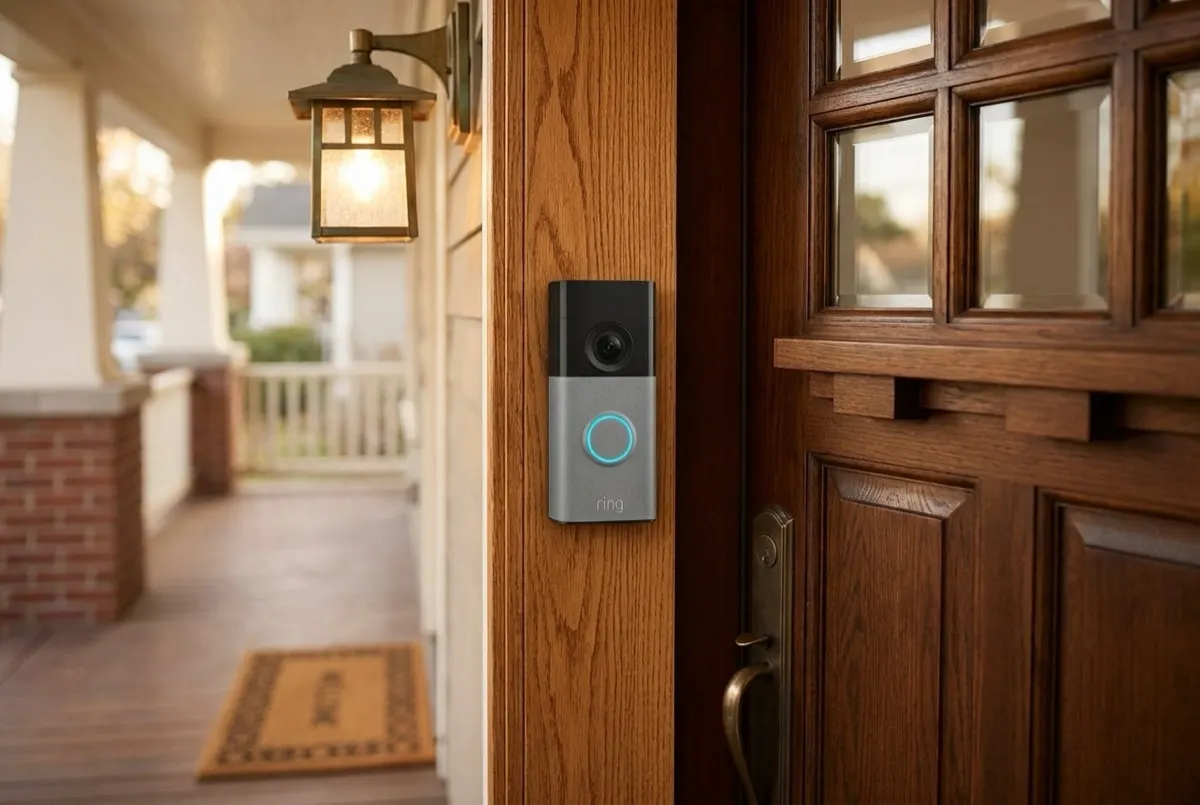
Ring Wired Doorbell Review: Retinal 2K With No Battery to Recharge
Wide-angle Retinal 2K
Up to 6x Enhanced Zoom
Hardwired 8-24V AC
Yes
Pros
- Wide-angle Retinal 2K with up to 6x Enhanced Zoom
- Constant hardwired power, no battery to ever recharge
- Compact body fits narrow door trim
- Live view, two-way talk, and alerts work with no subscription
Cons
- Recorded video history requires a paid Ring Home subscription
- No battery backup during a power cut
- Needs an existing 8-24V AC doorbell transformer
Best for
- Homes with existing doorbell wiring and a compatible chime
- Buyers who never want to recharge a doorbell battery
- Households already using Alexa and the Ring app
Spec comparison
| Spec comparison | Ring Wired Doorbell (newest model) | Aqara Video Doorbell G4 | eufy Video Doorbell E340 |
|---|---|---|---|
| Resolution | Wide-angle Retinal 2K | 1080p Full HD | — |
| Zoom | Up to 6x Enhanced Zoom | — | — |
| Power | Hardwired to existing doorbell wiring (8-24V AC) | 6 AA batteries (up to 4 months) or wired 12–24V AC / 8–24V DC | Wired (16–24V) or 6500mAh rechargeable battery |
| Two-way talk | Yes | — | — |
| Night vision | Infrared | Infrared | Color, dual-light system, up to 16 ft (5 m) |
| Field of view | 140° × 140° head-to-toe | 162° wide-angle (16:9) | Main camera 160°, second camera 120° |
| Storage | Cloud recording with a Ring Home subscription; save, share and replay ring, motion and Live View events for up to 180 days | HomeKit Secure Video, free 7-day Aqara cloud, or microSD up to 512GB in chime | Built-in 8GB (eMMC), no monthly fee |
| Connectivity | Wi-Fi 4, 2.4 GHz single-band; minimum 10 Mbps upload recommended for 2K | Wi-Fi 2.4 GHz (IEEE 802.11b/g/n); local streaming to Nest and Echo displays | 2.4GHz Wi-Fi (802.11 b/g/n), IP65 |
| Weather rating | Weather resistant, -20.5°C to 48.5°C | IPX3 | IP65 |
| Subscription | Required | Not required | Not required |
| Warranty | One-year limited warranty, including theft protection | 12-month limited warranty (Aqara US) | 12 months |
| Dimensions | 5.36 × 13.25 × 2.6 cm | Doorbell 141.5 × 65 × 30.4 mm (5.57 × 2.56 × 1.2 in); chime repeater 65.2 × 65 × 28.4 mm | 5.9 × 2.0 × 1.2 in (151 × 51 × 30 mm) |
| Face recognition | — | Local, on-device via Aqara Home app, no fee | — |
| Cameras | — | — | 2K front (2048×1536) + 1080p downward (dual) |
Methodology & sources
TestedThis review is backed by a validated long-term test record retained by Lena Carter.
Verified on August 8, 2026
The Ring Wired Doorbell is the answer to a specific frustration: never wanting to think about a doorbell's battery again. Where the Battery Doorbell trades wiring for the recurring chore of recharging, this newest wired model draws constant power from an existing doorbell transformer and simply never runs down. It is the most compact and the most affordable way into Ring's newest generation, and this version brings the same Retinal 2K sensor and 6x zoom that used to be reserved for pricier models down to the entry wired tier. For a home that already has a working wired chime, it is the path of least resistance to a modern video doorbell.
This review measures the Wired Doorbell against Ring's published specifications and its current subscription terms. As with every Ring, the hardware story and the subscription story are two different things, and a site built around avoiding monthly fees has an obligation to keep them separate and to be blunt about where the line falls.
Retinal 2K and 6x zoom at the entry tier
The most important thing about this doorbell is what it inherited. Wide-angle Retinal 2K is the same class of sensor that headlines Ring's newer, costlier doorbells, and finding it on the entry wired model is a genuine step up from the 1080p that used to define this price bracket. The resolution matters most in combination with up to 6x Enhanced Zoom, which lets a recorded clip be pushed in close enough to read a face, a delivery label, or a plate without dissolving into blocks. A doorbell that can only tell you someone was there is far less useful than one that can help say who, and the 2K-plus-zoom pairing is what moves this model into the second category.
Ring's image processing does the rest, taming the harsh backlight of a doorway so that a visitor framed against a bright sky keeps a visible face rather than becoming a dark outline. Because the doorbell is wired and never rationing battery, it can lean on that processing continuously without the power-saving compromises a battery model sometimes makes, and the live view wakes and streams promptly on demand.
That constant readiness is easy to underrate until it is compared with a battery model's behavior. A battery doorbell keeps its sensor asleep to preserve charge and wakes it when motion fires, which introduces a brief hesitation at the start of an event and on the first frame of a live view. A wired doorbell has no reason to sleep, so the response feels a step quicker and the beginning of an event is less likely to be clipped. Paired with the sharper Retinal 2K sensor, the effect is a doorbell that both sees more detail and captures it a moment sooner, which is exactly where a wired design earns its keep at the doorstep.
Constant power: the whole point
The defining trait of this doorbell is that it is always on. Wired to a standard 8-to-24-volt AC doorbell transformer, it never asks to be recharged, never slides out for a trip to a USB port, and never surprises anyone with a dead camera after a cold, busy week. For a doorway that sees heavy foot traffic, that constant power is not a minor convenience; it is the difference between a device that quietly works for years and one that demands maintenance. It also means the live view and two-way talk are ready instantly, with none of the wake-from-sleep hesitation that battery doorbells manage by design.
The flip side of drawing all its power from the wiring is the obvious one: no battery means no backup. If the household loses power, the doorbell goes dark until it returns. A battery model rides through a brief outage; this one does not. For most homes that is an acceptable trade for never recharging, but anyone in an area prone to outages, or anyone who wants the camera watching precisely when the grid is down, should weigh that gap honestly.
Installation assumes existing doorbell wiring and a compatible chime, and that requirement is the real gate on this product. A home already wired for a traditional doorbell is a quick swap: kill the breaker, unclip the old button, connect two low-voltage wires, and mount. A home with no doorbell wiring cannot use this model at all and should look at the Battery Doorbell instead. It is worth confirming the transformer and chime are compatible before ordering, because a marginal or missing transformer is the most common installation snag with any wired doorbell.
A wide, tall field of view
The Wired Doorbell shoots a wide-angle view designed to show a caller head to toe and to reveal what sits on the ground directly below it. That tall framing is exactly what a doorstep needs, because a package left on the mat is invisible to the letterbox-shaped view that older and cheaper doorbells used. Seeing the parcel, not just the person, is a large part of why a video doorbell earns its place, and the wide-angle geometry here delivers it along with fewer blind spots across the porch.
Night vision, two-way talk, and motion
After dark the doorbell uses infrared night vision to keep the doorstep visible, covering the area where a visitor actually stands to ring or knock. Two-way talk is clear enough for a real exchange with a courier or a caller, and it benefits from the constant power that keeps the radio responsive. Motion detection supports customizable zones and adjustable sensitivity, which is essential at a door facing a street or sidewalk: zones let the camera ignore passing cars and pedestrians and alert only on the walkway and porch, which is the single most effective way to avoid the notification fatigue that makes people mute their doorbells entirely.
Chime compatibility and what wiring actually gives you
Because the Wired Doorbell draws from the doorbell circuit, it can do something the battery model handles differently: ring an existing indoor chime. A traditional mechanical chime, the kind with a physical bell that many older homes have, generally works directly. A newer digital chime, which plays a synthesized tone, can interfere with a wired doorbell's power and usually needs a small in-wall adapter to behave, a common step that is worth checking before installation rather than discovering afterward. Homes with no interior chime at all can route the announcement to an Echo speaker or a plug-in chime accessory instead.
The transformer is the other half of the compatibility question. The doorbell expects standard 8-to-24-volt AC power, which most homes with an existing wired button already supply, but a very old or undersized transformer can leave the camera underpowered and prone to dropouts. Confirming the transformer meets that range is the surest way to avoid the single most common wired-doorbell headache. Get the power and chime right, and the reward is a doorbell that never needs a thought again; get them wrong, and the symptoms are exactly the intermittent behavior that constant power is supposed to eliminate.
The Ring app and privacy controls
Ring's software is the same polished platform across the lineup, and on a wired doorbell its responsiveness is at its best because the camera is never rationing power. Live View opens the doorstep on demand and connects promptly, and rich notifications can carry a snapshot so a glance often answers who is there without opening the app. Quick Replies let the doorbell speak a pre-recorded message to a visitor when tapping the alert in time is not possible, and Modes switch the whole setup between Home, Away, and Disarmed states in one move.
The privacy controls deserve the same emphasis here as anywhere. Adjustable privacy zones let an owner permanently exclude parts of the frame, such as a neighbor's door or a public sidewalk, from being recorded, and the microphone can be disabled for anyone who wants images without capturing audio from passersby. These settings are meaningful for a camera that stares at a shared street all day, and they sit alongside the subscription question rather than resolving it: the software respects privacy choices, even as recorded history remains a paid feature.
Working with Alexa and Echo Show
Inside an Amazon household the Wired Doorbell is at home. A press can trigger an Echo Show to announce the caller and bring the live feed up on its screen automatically, and a spoken request pulls the front-door view onto any compatible display. Two-way talk runs through the Echo, so a visitor can be answered from the kitchen counter with no phone involved, and doorbell events can be woven into Alexa routines that announce across every speaker or arm the camera as part of a leaving-the-house sequence.
That integration is the quiet advantage that keeps buyers inside the Ring and Alexa world despite the subscription. Competing doorbells can be made to work with smart displays, but few match the plug-and-play smoothness of a Ring device announcing itself on an Echo Show the moment it is added to the same account. For a home already invested in Amazon's speakers and screens, that seamlessness is a real part of the value.
The Ring Home subscription, stated plainly
The same clear line has to be drawn here as with any Ring. Without a Ring Home subscription, the Wired Doorbell is still a functional live intercom: it streams live video on demand, supports two-way talk, and pushes real-time motion and doorbell-press notifications, so a household can see and speak to a visitor in the moment. As a real-time deterrent and doorway intercom, it needs no plan.
What it cannot do without a plan is save video. There is no local storage on this doorbell, so a missed notification means a missed event with no clip to review later. Recorded event history, the ability to scroll back through the day, smarter person and package alerts, and video preview thumbnails all require an active Ring Home subscription, with longer retention available on the plan as well. The hardware captures beautifully; the memory is rented. That is the honest core of owning a Ring, and it applies to the wired model exactly as it does to the battery one.
For a buyer weighing this against the subscription, the calculus is straightforward. If a monthly fee for a polished, deeply integrated system is acceptable, the Wired Doorbell is a superb value at the entry tier. If a subscription is a dealbreaker, no amount of sensor quality changes the fact that the feature most people buy a doorbell for lives behind a recurring charge, and a local-storage doorbell is the better philosophical fit.
Long-term ownership and durability
A wired doorbell carries a durability advantage that rarely makes the spec sheet: it has no battery to age. Every battery-powered doorbell holds a rechargeable cell that slowly loses capacity over years of charging cycles, until a pack that once lasted weeks needs topping up every few days and eventually asks to be replaced. A constantly wired device sidesteps that decline entirely. Drawing steady low-voltage power, it is built to run for years with no maintenance beyond the occasional software update, and those updates arrive automatically through the app to keep the security and features current over time.
The hardware is made for the weather it faces. Mounted outdoors, it is weather-resistant across the temperature swings a porch endures through winter and summer, and with no battery compartment to seal, there is one fewer point of ingress to worry about. For an owner who wants to install a doorbell once and simply forget it exists until it announces a visitor, that maintenance-free profile is the quiet argument for going wired. The camera that never needs charging is also the camera that never surprises anyone with a dead battery on the day a package is due, and over a span of years that reliability compounds into the most convincing reason to choose this model over its battery sibling for a home that has the wiring to support it.
Wired versus Battery: which Ring to choose
For a household choosing between the two newest Ring doorbells, the decision is refreshingly simple and comes down to the front door, not the feature list. Both share the Retinal 2K path, both offer 6x zoom, both require Ring Home for recorded history, and both integrate identically with Alexa and the Ring app. The Wired Doorbell costs less, is more compact, and never needs charging, but it demands existing doorbell wiring and offers no power-cut backup. The Battery Doorbell installs anywhere, wiring or not, and rides through outages, at the price of periodic recharging. A wired home that wants the lowest price and zero maintenance should take the Wired model; a renter, or a home with no wiring, should take the Battery model. The image and the subscription are the same either way.
Who should buy it
The Wired Doorbell is the right choice for a home that already has a working wired chime and wants the simplest long-term ownership: mount it once and forget it. It is an especially strong pick for households inside the Alexa and Ring ecosystem, where an Echo Show can announce callers and the app unifies every device. For anyone comfortable with a subscription, it is the most affordable way to get Ring's newest 2K sensor and 6x zoom at the door.
Who should skip it
Renters and homes without doorbell wiring should skip it outright and choose the Battery Doorbell, which needs no transformer. Subscription-averse buyers should skip it because recorded history is gated behind Ring Home with no local alternative. And anyone who specifically wants the doorbell recording during a blackout should prefer a battery-backed model, since this one goes dark when the power does.
How it compares
Against the Ring Battery Doorbell, the split is purely power and permanence: constant wired power and a lower cost here, versus install-anywhere flexibility and outage tolerance there, with identical image quality and the same Ring Home requirement. Against a wired local-storage doorbell such as a Eufy model, the trade is the familiar one: Eufy keeps recordings on a home base with no monthly fee, directly answering the subscription objection, while Ring counters with faster response, a more refined app, and superior Alexa integration. The Wired Doorbell is the pick for polish and ecosystem inside a wired home; a local-storage rival is the pick for ownership without recurring cost.
Verdict
The Ring Wired Doorbell brings the newest generation's Retinal 2K sensor and 6x zoom to the most affordable, lowest-maintenance form Ring offers, and for a home that already has doorbell wiring it is close to the easiest recommendation in the lineup. Constant power means it simply works, the wide head-to-toe view catches packages and callers alike, and the compact body suits narrow trim. The reservations are the wiring requirement, the lack of outage backup, and, above all, the unavoidable truth that recorded video requires a Ring Home subscription with no local option. For a wired household that accepts a monthly fee, this is an excellent doorbell at a friendly entry point. For anyone who treats subscriptions as a hard line, the hardware's quality cannot change the answer.
Editorial summary
The newest Ring Wired Doorbell brings Retinal 2K and 6x zoom to a compact, never-recharge doorbell, but saved recordings still need a Ring Home plan.
Subscription math
Ring Wired Doorbell (newest model) · $4.99 per month
| Period | Device only | Device + subscription |
|---|---|---|
| 1 year | $79.99 | $139.87 |
| 3 years | $79.99 | $259.63 |
| 5 years | $79.99 | $379.39 |
Where to buy
Check the merchant for the current price and availability. We may earn a commission.