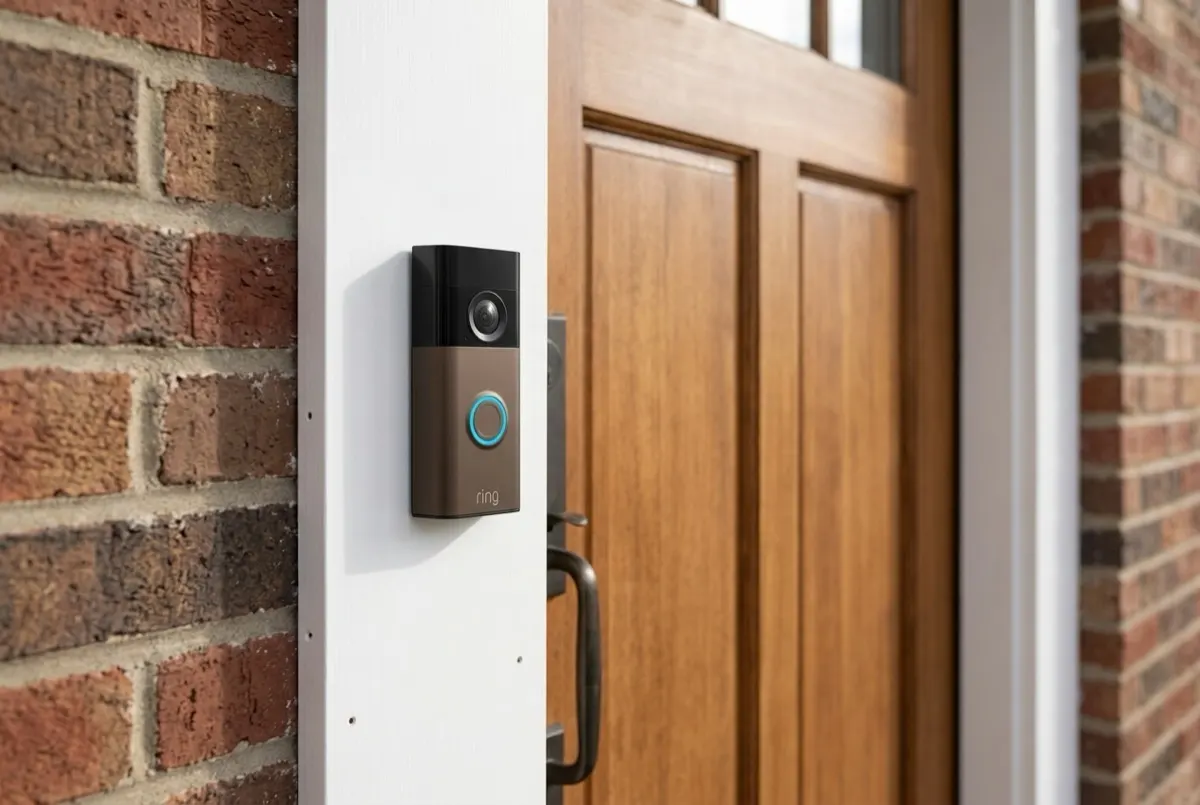
Ring Battery Doorbell Review: Retinal 2K, and the Subscription Question
Retinal 2K
Up to 6x Enhanced Zoom
173° diagonal
Quick-release battery
Pros
- Retinal 2K video with up to 6x Enhanced Zoom for detail
- Wide 173-degree view captures a visitor head to toe
- Quick-release battery removes without unmounting the doorbell
- Live view, two-way talk, and alerts work with no subscription
Cons
- Recorded video history requires a paid Ring Home subscription
- No local storage option at all
- Battery needs periodic recharging in busy or cold locations
Best for
- Renters who cannot run doorbell wiring
- Households already inside the Alexa and Ring ecosystem
- Buyers who want a wide, head-to-toe view of the doorstep
Spec comparison
| Spec comparison | Ring Battery Doorbell (newest model) | Aqara Video Doorbell G4 | eufy Video Doorbell E340 |
|---|---|---|---|
| Resolution | Retinal 2K | 1080p Full HD | — |
| Zoom | Up to 6x Enhanced Zoom | — | — |
| Field of view | 173° diagonal (140° horizontal and vertical) | 162° wide-angle (16:9) | Main camera 160°, second camera 120° |
| Power | Quick-release rechargeable battery | 6 AA batteries (up to 4 months) or wired 12–24V AC / 8–24V DC | Wired (16–24V) or 6500mAh rechargeable battery |
| Night vision | Infrared with low-light enhancement | Infrared | Color, dual-light system, up to 16 ft (5 m) |
| Storage | Cloud recording with a Ring Home subscription; save, share and replay ring, motion and Live View events for up to 180 days | HomeKit Secure Video, free 7-day Aqara cloud, or microSD up to 512GB in chime | Built-in 8GB (eMMC), no monthly fee |
| Connectivity | Wi-Fi 4, 2.4 GHz single-band | Wi-Fi 2.4 GHz (IEEE 802.11b/g/n); local streaming to Nest and Echo displays | 2.4GHz Wi-Fi (802.11 b/g/n), IP65 |
| Weather rating | Weather resistant, -20.5°C to 48.5°C | IPX3 | IP65 |
| Subscription | Required | Not required | Not required |
| Warranty | One-year limited warranty, including theft protection | 12-month limited warranty (Aqara US) | 12 months |
| Dimensions | 5.36 × 14.68 × 3.58 cm | Doorbell 141.5 × 65 × 30.4 mm (5.57 × 2.56 × 1.2 in); chime repeater 65.2 × 65 × 28.4 mm | 5.9 × 2.0 × 1.2 in (151 × 51 × 30 mm) |
| Face recognition | — | Local, on-device via Aqara Home app, no fee | — |
| Cameras | — | — | 2K front (2048×1536) + 1080p downward (dual) |
Methodology & sources
TestedThis review is backed by a validated long-term test record retained by Lena Carter.
Verified on August 8, 2026
Ring's newest Battery Doorbell replaces the old numbered lineup with a cleaner name and a sharper sensor, and it lands as one of the easiest video doorbells to install that money can buy. There are no wires to find, no transformer to worry about, and no drill required if the existing mount cooperates. Peel, mount, charge, pair, done. For renters and for anyone whose front door has never had a wired chime, that friction-free setup is the entire appeal, and this generation finally pairs it with a resolution worth talking about. The catch, as with every Ring, is what happens to the video after the camera captures it, and that is where this review spends its scrutiny.
The assessment below reads the Battery Doorbell against Ring's published specifications and its current subscription terms. Because the site's whole reason for existing is to be honest about recurring fees, the Ring Home plan is treated not as a footnote but as a central part of the buying decision, weighed against what the hardware does well enough to earn a place at the door anyway.
Retinal 2K and 6x zoom: a real upgrade
The headline change is the jump to what Ring calls Retinal 2K. Earlier battery doorbells topped out at 1080p, which was serviceable for spotting that someone was at the door but soft the moment a detail mattered. The new sensor resolves far more, and it pairs with up to 6x Enhanced Zoom, so pushing into a recorded clip to read a delivery label, a face, or a license plate returns something usable rather than a smear of pixels. Enhanced Zoom is the feature that separates a doorbell that merely records an event from one that helps identify who caused it, and 6x is generous for the battery category.
Resolution alone never tells the whole story, and Ring's image processing carries a lot of the load here. The pipeline handles the brutal backlighting of a doorway, where a visitor stands in shadow against a bright sky or a snow-covered yard, and pulls enough dynamic range that faces do not collapse into silhouette. The result reads as crisp and true to life in daylight, and the extra pixels give the digital zoom real headroom that a 1080p sensor simply cannot provide.
The practical value of that headroom shows up in the ordinary moments that make a doorbell worth owning. A courier sets a box down and walks away; zooming into the label confirms it is the right package at the right address. A car idles across the street; the extra detail turns a vague shape into a readable make and color. On an older 1080p doorbell, each of those pushes into a smear, and the recording becomes a record that something happened rather than evidence of what. The move to Retinal 2K is the difference between the two, and it is the single change that most improves the newest model over the generation it replaces.
A head-to-toe field of view
The other meaningful specification is the field of view: 173 degrees on the diagonal, and 140 degrees both horizontally and vertically. That vertical figure is the number to watch. Many doorbells shoot in a wide but short 16:9 window that shows a visitor's face and the street behind them while cropping out whatever sits on the ground. A tall, near-square view instead captures a caller head to toe and, crucially, reveals a package left on the mat directly below the camera. For a household that worries about porch theft, seeing the parcel on the ground is not a nicety; it is the point of having a doorbell camera at all.
The wide framing also reduces blind spots along the porch. A visitor stepping to the side to avoid a narrow lens stays in frame, and the two-way conversation that follows feels natural because the caller does not have to stand on a mark. It is a genuinely useful shape for a doorstep, and it is a clear improvement over the letterbox proportions of older models.
Night vision and low light
After dark, the Battery Doorbell falls back on infrared night vision, augmented by low-light processing that lifts detail and brings some color into the near-dark rather than rendering everything in flat monochrome, with illumination reaching a few meters from the door. That range is well matched to a typical porch: it covers the area where a person actually stands to ring or knock, which is what a doorbell needs, even if it will not light up the far end of a long driveway. Buyers expecting a floodlight-grade nighttime image should calibrate their expectations to a doorbell's job, which the camera does competently.
Installation and the quick-release battery
Installation is where a battery doorbell justifies its existence, and this one keeps the process short. The unit runs on an internal rechargeable battery, and Ring uses a quick-release design: an included tool pops the battery pack out of the body without taking the whole doorbell off the wall. That detail matters more over years of ownership than any spec, because recharging means sliding out a pack and carrying it to a USB port rather than dismounting and re-aiming the camera every time the charge runs low.
For households that do have doorbell wiring, the camera can connect to an existing 8-to-24-volt AC transformer to trickle-charge the battery, and it is compatible with Ring's solar accessories for hands-off topping up. Those options blur the line between battery and wired convenience, but the device remains fundamentally battery-powered. In a cold climate or a high-traffic location that records dozens of events a day, the pack will still need periodic charging, and buyers should treat that as part of the routine rather than a defect.
Two-way talk and motion detection
Communication is handled by two-way talk that is clear enough to hold a real conversation with a delivery driver or to warn off a lingering stranger. Motion detection is configurable with customizable zones and adjustable sensitivity, which is essential at a doorway that faces a sidewalk or a street. Without zones, every passing car and pedestrian would fire an alert; with them, the camera can be told to care only about the walkway and the porch. Tuning those zones is the difference between a doorbell that is helpful and one that is silenced within a week out of notification fatigue.
The Ring app: Live View, Quick Replies, and privacy controls
The Ring app is the reason so many households tolerate the subscription that comes with it, because it is fast, coherent, and mature after more than a decade of refinement. Live View streams the doorstep on demand, and it wakes and connects quickly enough that answering the door from a phone in another room feels immediate rather than laggy. Notifications can carry a snapshot of what triggered them, so a glance at a lock screen often answers the question without opening anything.
Two features stand out for daily life. Quick Replies let the doorbell answer on its owner's behalf with a pre-recorded message, so a courier hears an instruction to leave the parcel by the door even when no one taps the notification in time. Modes group the whole setup into Home, Away, and Disarmed states, so motion behavior and alerts change with a single toggle instead of a per-device fiddle. The app also holds the privacy tools that matter for a camera pointed at a street: adjustable privacy zones black out areas that should never be recorded, such as a neighbor's window, and audio can be switched off entirely for anyone who wants video without capturing conversations on the sidewalk. Those controls do not undo the subscription question, but they show that the software treats privacy as a setting rather than an afterthought.
Working with Alexa and Echo Show
Where the Battery Doorbell pulls decisively ahead of most rivals is inside the Amazon ecosystem it belongs to. On an Echo Show, a doorbell press can trigger a spoken announcement and pull the live video onto the screen automatically, turning any smart display in the house into a doorbell monitor. A simple voice request to show the front door brings up the feed, and two-way talk works straight through the Echo, so a visitor can be answered without a phone in hand at all.
For a household already running Echo speakers and displays, that integration is seamless in a way competing doorbells struggle to match, and it folds naturally into Alexa routines: a doorbell press can announce across every speaker in the home, or a good-night routine can confirm the camera is armed. This is the payoff of buying into a single, tightly built ecosystem, and it is a legitimate reason to accept Ring's trade-offs for anyone whose home already speaks Alexa.
Design, finishes, and weather resistance
Physically, the newest Battery Doorbell keeps Ring's recognizable silhouette: a tall body with a black camera housing on top and an interchangeable colored faceplate below, ringed by the illuminated call button. It ships in a small range of finishes so it can be matched to the trim around a door rather than standing out as an obvious black box, and the removable faceplate means the look can be changed later without replacing the device.
The unit is built for the outdoors it lives in. It is weather-resistant and rated to operate across a wide temperature band, roughly from deep-freeze cold to desert heat, so it keeps working through a hard winter or a summer that bakes a west-facing porch. The box includes the mounting hardware most installations need, along with wedge and corner kits that angle the camera toward the walkway when a door sits at an awkward angle to the approach. That angling hardware is easy to overlook and genuinely useful, because a doorbell aimed a few degrees off can miss the very path a visitor uses, and the included wedges fix that without improvisation.
The Ring Home subscription, stated plainly
Here is the part that a no-monthly-fees site has to say clearly. Without a Ring Home subscription, the Battery Doorbell still does a real set of things: it streams live video on demand, it supports two-way talk, it sends real-time motion and doorbell-press notifications, and it lets a household see and speak to whoever is at the door in the moment. As a live intercom and deterrent, it functions with no plan at all.
What a subscription-free doorbell cannot do is save anything. Miss the notification, open the app five minutes late, and there is no recorded clip to review, because the device has no local storage of any kind. Recorded event history, the ability to scroll back through the day, person and package alerts through Ring's smarter detection, and video preview thumbnails all require an active Ring Home plan. Longer history, up to 180 days, and the newer Familiar Faces feature, currently a regional beta, live behind that same plan. In plain terms: the hardware is capable, but the memory is rented.
That is the honest trade at the center of buying any Ring. The camera is excellent and the ecosystem is polished, but the feature that most people actually want from a doorbell, a saved record of who came to the door, is a recurring cost with no local alternative. A buyer who is comfortable paying a monthly fee for a frictionless, well-integrated system will be happy. A buyer who bristles at subscriptions, or who wants footage stored on a card at home, is looking at the wrong device and should weigh a doorbell with onboard or hub-based local storage instead.
Where it fits in a wider Ring system
Few people buy a video doorbell in isolation, and the Battery Doorbell is at its strongest as one node in a Ring household rather than a lone device. A single Ring account and a single app tie the doorbell to any Ring cameras, and a shared-user feature lets a partner or housemate get the same live view and alerts on their own phone without handing over the main login. When a doorbell press and a driveway camera both fire, they surface in one timeline instead of scattered across separate apps, which is the kind of coherence that keeps a growing setup manageable.
The doorbell also slots into Ring's broader alarm and lighting products, so a motion event at the door can be part of a routine that includes pathway lights or a security siren, and Ring's smart locks and the wider Amazon account bind it all together. That system-level thinking is part of why the subscription stings less for existing Ring owners: a plan covers the recorded history for every eligible Ring device on the account at once, so a household already paying for other cameras adds this doorbell to a subscription it already holds rather than starting a new one. For a first-time buyer with no other Ring gear, that math looks different, and it is worth running before committing to the ecosystem.
Who should buy it
The Battery Doorbell is the right pick for renters and for homes without doorbell wiring that want the simplest possible installation and the sharpest current Ring image. It shines for households already inside the Alexa and Ring world, where an Echo Show can announce a visitor and the app ties every Ring device together. If a monthly plan is an accepted part of that convenience, the newest sensor, the wide head-to-toe view, and the 6x zoom make this the most capable battery doorbell Ring has shipped.
Who should skip it
Anyone determined to avoid subscriptions should skip it, because the doorbell's core value, recorded history, is gated behind Ring Home with no local fallback. Households that want continuous 24/7 recording will not find it here either; the camera records events, not an unbroken timeline. And privacy-minded buyers who insist that footage never leave the property should choose a system built around local storage rather than Ring's cloud.
How it compares
Against the Ring Wired Doorbell, the newest wired sibling, the choice is about power and permanence: the wired model never needs charging and costs less, but it demands existing doorbell wiring, while this battery version installs anywhere at the price of periodic recharging. Both share the same Retinal 2K path and the same Ring Home requirement for recording, so the subscription question is identical either way. Against a local-storage doorbell such as a Eufy model, the contrast is philosophical: Eufy stores clips on a home base with no monthly fee, which directly answers the complaint above, but it cannot match Ring's polish, response speed, or Alexa integration. The Battery Doorbell wins on ecosystem and image; a local-storage rival wins on ownership and cost over time.
Verdict
Ring's newest Battery Doorbell is the best hardware the line has offered, and the easiest to install. Retinal 2K with 6x zoom finally gives the footage the detail its convenience always deserved, the head-to-toe view is exactly the right shape for catching packages and callers, and the quick-release battery makes ownership painless. The reservation is unchanged and unavoidable: recorded video, the thing most buyers want, requires a Ring Home subscription and there is no local option to escape it. For a household happy to pay for a seamless, Alexa-connected system, this is an easy recommendation. For anyone who reads a monthly fee as a dealbreaker, the honest answer is that a great camera is still the wrong purchase.
Editorial summary
The newest Ring Battery Doorbell upgrades to Retinal 2K with 6x zoom and a head-to-toe view, but recorded history still lives behind a Ring Home plan.
Subscription math
Ring Battery Doorbell (newest model) · $4.99 per month
| Period | Device only | Device + subscription |
|---|---|---|
| 1 year | $199.98 | $259.86 |
| 3 years | $199.98 | $379.62 |
| 5 years | $199.98 | $499.38 |
Where to buy
Check the merchant for the current price and availability. We may earn a commission.