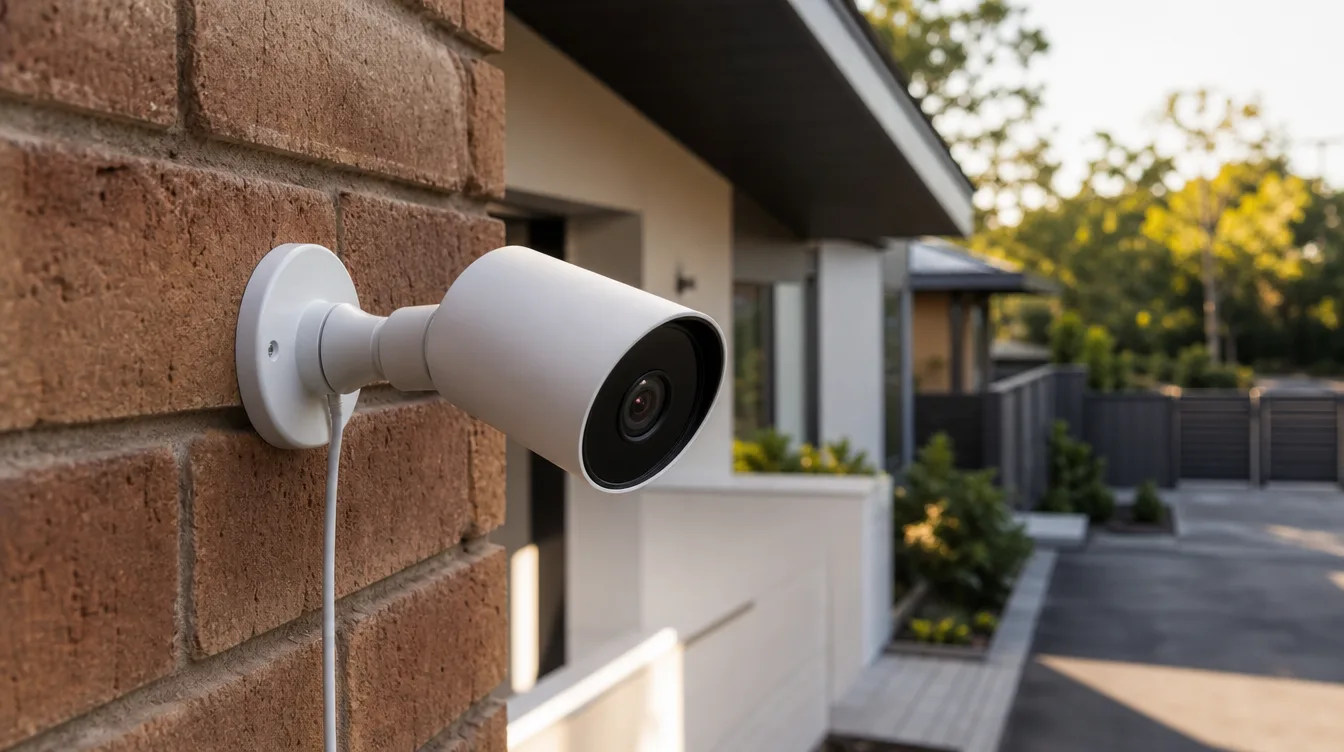
Reolink RLC-810A Review: 4K PoE and 24/7 Recording You Own
4K UHD (3840×2160)
PoE, single cable
microSD 512GB or NVR, 24/7
Infrared, up to 100 ft
Pros
- True 4K resolution over a single PoE cable carrying both power and data
- Records 24/7 to a microSD card or an NVR with no monthly fee
- Free on-device person, vehicle, and animal detection
- IP67 weatherproofing and 100 ft infrared night vision
Cons
- Requires PoE wiring and a little network know-how
- A microSD card or NVR is a separate purchase for recording
- Infrared-only night vision, so no color image after dark
- No battery or wireless option, and no Apple HomeKit
Best for
- Buyers who want continuous 24/7 recording, not just motion clips
- Homes that can run a single Ethernet cable to the camera
- DIY owners comfortable with a microSD card or an NVR
Spec comparison
| Spec comparison | Reolink RLC-810A | Amcrest IP5M-T1179EW | Arlo Pro 5S 2K |
|---|---|---|---|
| Resolution | 4K UHD (3840×2160) at 25 fps, 1/2.7-inch CMOS | 5MP (2592×1944), 1/2.7-inch CMOS | 2K HDR |
| Field of view | 87° horizontal (4mm lens) | 132° super-wide | 160° |
| Night vision | Infrared, 18 LEDs, up to 100 ft (30 m), black and white | Infrared LEDs, up to 98 ft (30 m) | — |
| Storage | microSD up to 512GB or Reolink NVR, 24/7 recording, no fee | microSD up to 256GB, Amcrest NVR, NAS, FTP or PC, no fee required | Cloud recording with an Arlo Secure plan (trial included); local storage with compatible SmartHub/Base Station (VMB4000, VMB4500, VMB4540, VMB5000) |
| Power | Power over Ethernet (802.3af) or DC 12V, single cable | Power over Ethernet, requires a PoE switch or injector (not included) | Rechargeable swappable battery |
| Weatherproofing | IP67 | IP67 | — |
| Connectivity | Wired PoE (single network cable for power and data) | Wired PoE (single Ethernet cable carries power and data); works with Amcrest Surveillance Pro, Blue Iris and mainstream browsers | Dual-band Wi-Fi |
| Subscription | Not required | Not required | Required |
| Warranty | 2-year limited warranty | 1-year replacement warranty with 30-day money-back guarantee (Amcrest US) | Limited hardware warranty, generally one year from date of purchase |
| Dimensions | Ø66 × 192 mm | 3.7 × 3.7 × 3.2 in, 1.04 lbs | 3.5 × 2.0 × 3.0 in (89 × 52 × 78.4 mm) |
| Night Vision | — | — | Color (integrated spotlight) |
| Weather rating | — | — | Weather-resistant, operating temperature -4°F to 113°F (-20°C to 45°C) |
Methodology & sources
TestedThis review is backed by a validated long-term test record retained by Lena Carter.
Verified on August 8, 2026
Every no-subscription camera on this site fights the same fight from a different angle: how to keep a saved record of the footage without renting cloud space by the month. Battery cameras answer it with a card inside the camera and event clips only. The Reolink RLC-810A answers it the way a professional installer would, by running a wire. It is a 4K Power-over-Ethernet camera that draws power and sends video down one cable to a network video recorder or a microSD card in your own home, and it keeps recording every second of the day. For this camera there is no subscription to escape, because a wired camera writing to local storage was never part of the cloud model in the first place.
This review reads the RLC-810A against Reolink's published specifications and the way a wired PoE system actually works. Because the point of this site is to be honest about recurring fees, the no-monthly-cost claim is examined first, then weighed against the real demands a PoE camera makes on the person installing it.
4K resolution over a single cable
The RLC-810A captures true 4K Ultra HD (3840 by 2160) at 25 frames per second through a 1/2.7-inch CMOS sensor behind an f/2.0 fixed lens, giving an 87-degree horizontal field of view on the common 4mm version. Eight megapixels is a lot of detail for a camera at this end of the market, and detail is exactly what a security camera is for: pushing into a recorded frame to read a plate, make out a face, or confirm the color of a jacket returns something usable rather than a block of pixels.
The delivery method is the quiet headline. Power over Ethernet means a single Cat5e or Cat6 cable carries both the electricity and the video, so the camera needs no separate power adapter at the mounting point and no Wi-Fi radio fighting for bandwidth. One run of cable back to a PoE switch or recorder, and the camera is fed and connected at once. For a fixed outdoor position watching a driveway, a gate, or a side yard, that wired link is more stable than any battery-and-Wi-Fi camera can promise, and it never asks to be recharged.
The 24/7 difference
Here is the capability that sets the RLC-810A apart from most of the cameras on this site. Because it draws constant power over the Ethernet cable, it is not rationing a battery, so it can record continuously, an unbroken timeline of every second, rather than waking on motion to capture a clip. It supports 24/7 continuous recording alongside motion-triggered and scheduled modes, and that is a genuinely different class of coverage.
A motion-only camera tells you that something moved and hands you a clip that starts a fraction of a second after the trigger. A continuous recorder captures the lead-up, the event, and the aftermath as one scrubbable stream, so nothing that happens in front of the lens is ever missed because a passive sensor failed to fire. For a business, a driveway that sees constant traffic, or anyone who wants to scroll back to an exact moment rather than hunt through disconnected events, that unbroken timeline is the reason to choose a wired camera, and it is the specific gap this pick fills in the lineup.
Storage you own, no plan attached
The RLC-810A records to storage you control. It takes a microSD card up to 512GB in the camera itself, and it is built to work with a Reolink NVR for larger, multi-camera setups that hold weeks of continuous footage across several drives. Either way, the recording lives on hardware in your home, and Reolink charges nothing to view, play back, or export it. A cloud plan exists as an option for off-site backup, but it is genuinely optional rather than a gate in front of the footage.
Set that against the doorbells and cameras that keep their recordings in the cloud: there the saved history, the very thing most people want, is billed every month for as long as the camera hangs on the wall. The RLC-810A simply removes that line item. It also speaks the standard RTSP and ONVIF protocols, so the stream can feed a Reolink recorder or third-party software such as a home Blue Iris or Frigate setup, which is exactly the kind of ownership a buyer shopping to avoid subscriptions is after. The trade is that recording is not free out of the box in the literal sense: a microSD card or an NVR is a separate purchase, and it is worth budgeting for one alongside the camera.
Night vision: infrared, and the honest limit
After dark the RLC-810A relies on a bank of 18 infrared LEDs rated to reach up to 100 feet (about 30 meters), with 3D digital noise reduction to keep the image clean. That is a long throw for a camera at this price, and it covers a driveway or a yard comfortably in total darkness.
The honest caveat is that this is infrared, which means the nighttime image is black and white, not color. Several other cameras on this site, the eufy and TP-Link models among them, use a starlight sensor or a spotlight to hold full color after dark, and color is what turns "a person in a dark jacket" into "a person in a red jacket." The RLC-810A trades that for reach and simplicity: it sees far into the dark, but it describes what it sees in monochrome. For many wired installs watching a large area that is the right trade, but a buyer who specifically wants color night vision should know this camera does not offer it.
Smart detection without a plan
The camera runs its person, vehicle, and animal detection on-device, so alerts distinguish a delivery van or a visitor from a swaying branch without any cloud analysis or subscription. Motion zones let it ignore a busy street and care only about the walkway, which is the single most effective way to keep notifications meaningful rather than constant. A time-lapse feature rounds out the package for anyone who wants a compressed record of a long day. None of it sits behind a plan; the detection that competitors reserve for a paid tier is included with the hardware.
Installation: the PoE reality
This is the section that decides whether the RLC-810A is the right camera for a given buyer, because a wired PoE camera asks more of its installer than a battery unit does. The camera is IP67-rated against dust and rain and built to live outdoors year-round, and it is powered by standard 802.3af PoE, so a modest PoE switch or a Reolink PoE NVR feeds it directly. But the cable has to get from that switch to the mounting point, which usually means drilling an exterior wall, fishing a run through an attic or soffit, and terminating an Ethernet connector.
For a homeowner comfortable with that, it is an afternoon's work and the reward is a camera that never needs charging and never drops off Wi-Fi. For a renter, or anyone unwilling to run cable, it is a non-starter, and a wireless camera is the better fit. The RLC-810A is emphatically a DIY-and-own-it product rather than a peel-and-stick one, and that is the price of the reliability and the 24/7 recording it delivers.
Who should buy it
The RLC-810A is the right camera for a homeowner who wants continuous, subscription-free 4K coverage of a fixed spot and is willing to run a cable to get it. It suits people who value an unbroken 24/7 timeline over motion clips, who want their footage on a card or an NVR they physically own, and who are comfortable pairing the camera with a microSD card or a recorder. It is the wired backbone of a no-fee setup in a way a battery camera cannot be.
Who should skip it
Renters and anyone who cannot or will not run Ethernet should skip it and choose a wireless camera instead. Buyers who want color night vision straight out of the box should look at a starlight or spotlight model, because this camera sees in infrared black and white after dark. And Apple households should note it works with Google Assistant but not with Apple HomeKit, so it will not answer to Siri or appear in the Home app.
How it compares
Against the Reolink Argus 4 Pro reviewed here, the split is power and permanence: the Argus is wire-free and solar-friendly for renters, but it records only motion events on battery power, while the RLC-810A trades that flexibility for a wire, constant power, and a true 24/7 timeline. Against the flagship eufyCam S3 Pro, the eufy wins on wireless convenience and full-color night vision with its HomeBase, whereas the RLC-810A wins on outright simplicity of ownership and cost, feeding a standard NVR over a single cable. And against the budget TP-Link Tapo C120, the Tapo is the cheaper plug-in pick with color night vision, while the RLC-810A is the step up for anyone who wants 4K detail and genuine continuous recording. The pillar's local-storage story runs through this camera: it is the pick for the buyer who wants to own every second, not just the clips.
Verdict
The Reolink RLC-810A is the wired, own-it-outright answer to the subscription question this site keeps asking. Its 4K sensor resolves real detail, Power over Ethernet makes it maintenance-free once the cable is run, and its support for 24/7 continuous recording to a microSD card or an NVR delivers the unbroken timeline that motion-only cameras cannot. The compromises are exactly what a wired PoE camera implies: an installation that involves running cable, a card or recorder bought separately, infrared rather than color night vision, and no HomeKit. For a homeowner who wants to record everything and pay for it once, it is the most straightforwardly ownable camera on the site.
Frequently asked questions
Does the Reolink RLC-810A need a subscription?
No. The camera records to a microSD card in the camera or to a Reolink NVR, and viewing, playback, and export all work with no monthly plan. An optional cloud service exists for off-site backup, but every core feature, including 4K recording and smart detection, runs without it.
Can it really record 24/7, not just motion clips?
Yes. Because it takes constant power over the Ethernet cable, it supports continuous 24/7 recording as well as motion-triggered and scheduled modes. Paired with an NVR or a large microSD card, it keeps an unbroken timeline you can scrub through rather than a series of separate event clips.
What do you need to install it?
A single Ethernet cable run from the camera to a PoE switch or a Reolink PoE NVR, which supplies both power and the network connection. Mounting usually involves drilling an exterior wall and routing the cable, so it suits homeowners comfortable with a little DIY rather than renters who cannot run wiring.
Does it have color night vision?
No. The RLC-810A uses infrared LEDs for night vision, reaching up to 100 feet, and the nighttime image is black and white. Buyers who want full-color footage after dark should look at a starlight-sensor or spotlight camera instead.
Editorial summary
The Reolink RLC-810A is a 4K PoE camera that records 24/7 to a microSD card or an NVR you own, so there is no subscription to escape because the footage was never in the cloud.
Where to buy
Check the merchant for the current price and availability. We may earn a commission.