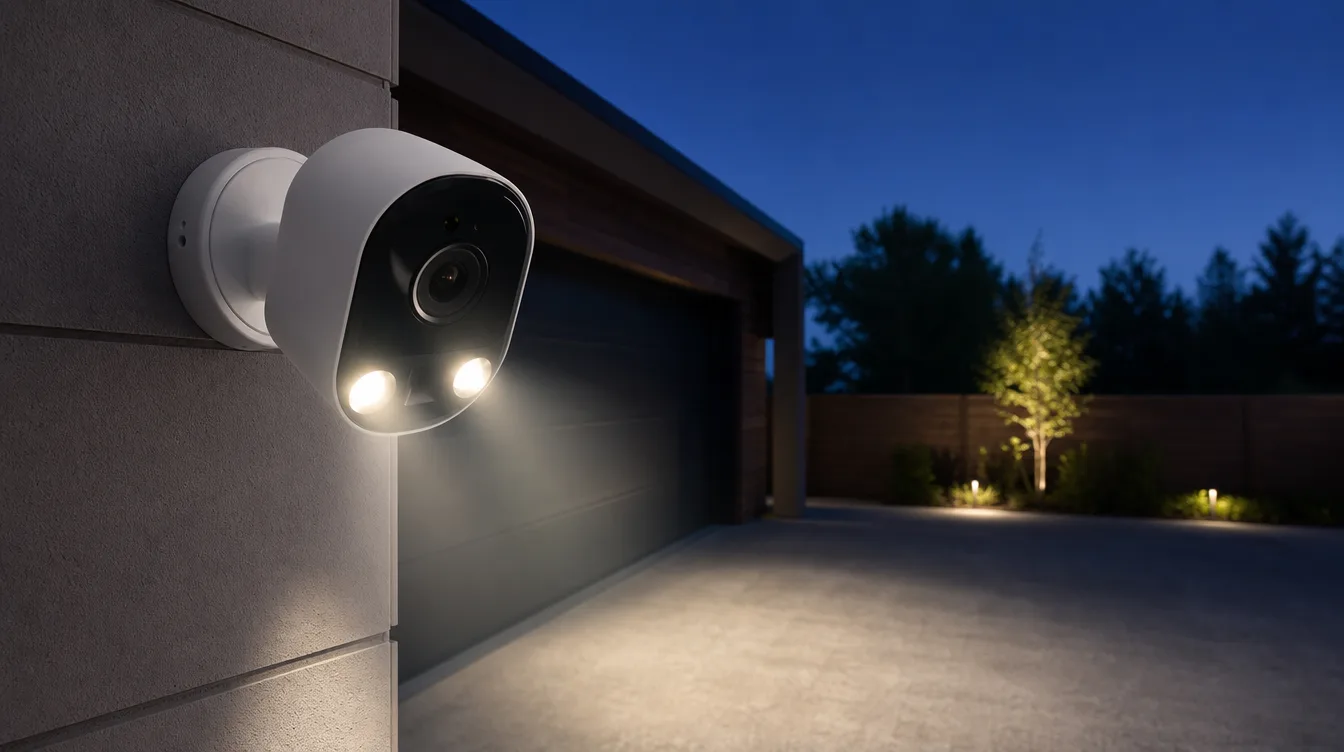
Lorex 4K Spotlight Review: 4K Wi-Fi, Local Storage, No Subscription
4K UHD (3840×2160)
Color, infrared to 32 ft
microSD 256GB, 32GB included
Plug-in, indoor/outdoor
Pros
- True 4K resolution streamed over faster, more stable Wi-Fi 6
- Color night vision holds full color in low light, infrared to 32 ft in the dark
- Ships with a 32GB microSD card and takes up to 256GB, no monthly fee
- Motion spotlights, customizable smart lighting, and a remote siren deter intruders
Cons
- Records only to a microSD card; no NVR or recorder expansion
- 4K is capped at 15 frames per second, lower than some rivals
- Needs a power outlet, so it is not wire-free or cable-free
Best for
- Buyers who want 4K Wi-Fi with a microSD card already in the box
- Homes that want spotlight and siren deterrence, not just a recording
- Owners near an outlet who prefer plug-in power over battery or PoE
Spec comparison
| Spec comparison | Lorex 4K Spotlight Wi-Fi 6 | Amcrest IP5M-T1179EW | Arlo Pro 5S 2K |
|---|---|---|---|
| Resolution | 4K UHD (3840×2160) at 15 fps, 8MP CMOS | 5MP (2592×1944), 1/2.7-inch CMOS | 2K HDR |
| Field of view | 140° diagonal, 2.8mm fixed lens | 132° super-wide | 160° |
| Night vision | Color night vision, infrared fallback up to 32 ft | Infrared LEDs, up to 98 ft (30 m) | — |
| Storage | microSD up to 256GB, 32GB card included, no fee | microSD up to 256GB, Amcrest NVR, NAS, FTP or PC, no fee required | Cloud recording with an Arlo Secure plan (trial included); local storage with compatible SmartHub/Base Station (VMB4000, VMB4500, VMB4540, VMB5000) |
| Power | Plug-in 12V DC adapter, 9.8 ft cable, indoor/outdoor IP65 | Power over Ethernet, requires a PoE switch or injector (not included) | Rechargeable swappable battery |
| Connectivity | Dual-band Wi-Fi 6 (802.11ax) | Wired PoE (single Ethernet cable carries power and data); works with Amcrest Surveillance Pro, Blue Iris and mainstream browsers | Dual-band Wi-Fi |
| Weather rating | IP65 (-20°C to 55°C) | — | Weather-resistant, operating temperature -4°F to 113°F (-20°C to 45°C) |
| Subscription | Not required | Not required | Required |
| Warranty | One-year limited warranty | 1-year replacement warranty with 30-day money-back guarantee (Amcrest US) | Limited hardware warranty, generally one year from date of purchase |
| Dimensions | 3.44 × 3.07 × 3.07 in (87 × 78 × 78 mm) | 3.7 × 3.7 × 3.2 in, 1.04 lbs | 3.5 × 2.0 × 3.0 in (89 × 52 × 78.4 mm) |
| Weatherproofing | — | IP67 | — |
| Night Vision | — | — | Color (integrated spotlight) |
Methodology & sources
TestedThis review is backed by a validated long-term test record retained by Lena Carter.
Verified on August 8, 2026
The no-subscription cameras on this site split into two camps. Wire-free battery cameras answer the storage question with a card or a HomeBase and event clips only, and wired PoE cameras answer it by running Ethernet to a recorder that never sleeps. The Lorex 4K Spotlight sits deliberately between them. It is a plug-in Wi-Fi camera, so there is no battery to recharge and no Ethernet to fish through a wall, and it records true 4K to a microSD card that Lorex puts in the box, so the footage lives at the house and Lorex charges nothing to view or export it. For a buyer who wants 4K detail and genuine local storage without either a battery habit or a cabling project, that middle path is the appeal, and the built-in spotlights and siren add a layer neither of the other camps includes by default.
This review reads the 4K Spotlight against Lorex's published specifications and the way a plug-in, locally recording Wi-Fi camera actually works. Because this site exists to be honest about subscriptions, the no-fee, storage-included claim gets examined first, then weighed against the real limits of a card-only camera.
4K over Wi-Fi 6, with the card in the box
The camera captures true 4K Ultra HD (3840 by 2160) through an 8-megapixel sensor behind a 2.8mm lens that takes in a wide 140-degree field of view, enough to cover a driveway, a porch, or a back yard from a single mount. Eight megapixels is real detail, the kind that lets a recorded frame be pushed into to read a face or a plate rather than dissolving into blocks.
Two specification choices set it apart from a typical Wi-Fi camera. The first is Wi-Fi 6: the camera uses the newer 802.11ax standard, which handles a 4K stream more reliably on a busy home network than the older Wi-Fi most cameras still ship with, so a high-resolution feed is less likely to stutter when the network is crowded. The second is the storage story. A 32GB microSD card is included, and the slot accepts cards up to 256GB, so recording works the moment the camera is mounted, with nothing extra to buy to keep the footage. That matters because a great many "no-subscription" cameras still expect a card purchase before they will record locally at all; here the card is already in the box.
Color night vision, and the honest fallback
After dark the 4K Spotlight leads with color rather than the black-and-white infrared most cameras drop to. Its color night vision uses the sensor and ambient light, helped by the camera's own spotlights, to hold a full-color image in low light, and color is what turns "a person in a dark jacket" into "a person in a red jacket," which is exactly the detail a security clip is for.
The honest caveat is that color night vision depends on some light to work with. When a scene falls to near-total darkness and the spotlights are not triggered, the camera switches to infrared and the image becomes black and white, with an infrared range rated up to about 32 feet. That is a shorter reach than a dedicated infrared camera built for long-distance darkness, so the 4K Spotlight is at its best watching an area that has some ambient or motion-triggered light rather than a pitch-black field at the edge of a large property.
Spotlights, smart lighting, and a siren
Deterrence is where this camera earns its name and separates itself from a plain recorder. It carries dual motion-activated LED spotlights that snap on when something moves, both to light the scene for color footage and to signal that the area is watched. Beyond the white security light, the smart lighting can be set to any of millions of colors for accent or ambience, so the same fixture that deters a prowler at night can wash a porch in warm light on an ordinary evening. A remotely triggered siren rounds out the active response: rather than only recording an intruder, the camera can light them up and sound an alarm from the app. For a buyer who wants a camera that does something at the moment of an event rather than simply logging it for later, that combination is the reason to choose this model.
Smart detection without a plan
The 4K Spotlight runs smart motion detection with four categories, distinguishing a person, a vehicle, an animal, and a package rather than firing on every swaying branch. That specificity is the single most effective way to keep notifications meaningful, and the package category is a genuinely useful touch for a front-door camera. Crucially, all of it runs with the local storage and no monthly fee: the detection that many competitors reserve for a paid tier is included with the hardware here, so a person alert or a package notification costs nothing beyond the camera.
Storage you own, and the honest limit
The 4K Spotlight records to the microSD card in the camera, and that footage is yours to view, scrub, and export at no charge. There is no cloud plan gating the recordings, which is the whole point on this site: the saved history that doorbell and camera makers so often bill by the month simply is not a line item here.
The honest limit is worth stating plainly, because it is the trade for that simplicity. Storage is card-only. Unlike a wired PoE camera that feeds a network video recorder holding weeks of footage across several drives, the 4K Spotlight does not expand onto an NVR or a Lorex recorder; when the 256GB card fills, the oldest footage is overwritten. For a single camera watching one important area that is usually plenty, but a buyer planning a multi-camera system with a central, long-retention recorder should know this model keeps its footage on its own card rather than pooling it. The camera is IP65-rated against dust and rain and specified to run outdoors across a wide temperature band, so the card is the constraint, not the weather.
Installation: plug-in, not wire-free
The 4K Spotlight is powered by a plug-in adapter on a roughly ten-foot cable, which shapes where it can go. This is not a battery camera that mounts anywhere, and it is not a PoE camera that draws power and data down one Ethernet run; it needs a standard power outlet within reach of its cable, or an extension routed to one. For a spot near a covered outlet, a soffit, or an eave close to indoor power, that is a five-minute mount and the reward is a camera that never needs recharging and never drops its power. For a far corner of a property with no outlet nearby, it is the wrong tool, and a battery-and-solar camera fits better. Plug-in power is the middle ground between the two other camps: easier than PoE, more fixed than battery.
Who should buy it
The 4K Spotlight is the right camera for a buyer who wants 4K detail and true local storage without a battery to manage or Ethernet to run, and who has an outlet within reach of the mount. It suits homes that want active deterrence, the spotlights and siren, rather than a silent recorder, and anyone glad to have the microSD card included so recording works out of the box. It is a strong single-camera pick for a driveway, a porch, or a back door with nearby power.
Who should skip it
Renters and anyone mounting a camera far from an outlet should choose a wire-free battery model instead. A buyer building toward a multi-camera system with a central recorder and long retention should look at a PoE-and-NVR setup rather than a card-only camera. And anyone who needs 4K at a high frame rate for fast motion should note this camera captures 4K at 15 frames per second, which is smooth for a security scene but lower than some rivals.
How it compares
Against the wire-free eufyCam S3 Pro, the Lorex trades the eufy's battery-and-solar freedom and expandable HomeBase storage for the simplicity of plug-in power and a card that ships in the box, plus built-in spotlights and a siren the eufy handles differently. Against the wired Reolink RLC-810A, the split is power and storage depth: the Reolink runs Ethernet for constant power and 24/7 recording to an NVR, while the 4K Spotlight skips the cabling for a plug-in outlet and keeps its footage on its own microSD card. And against the budget TP-Link Tapo C120, the Lorex steps up with 4K resolution and active spotlight-and-siren deterrence rather than a smaller plug-in camera's quieter recording. It is the pick for a buyer who wants owned 4K footage and a camera that acts at the moment of an event, without a battery habit or a wiring project.
Verdict
The Lorex 4K Spotlight is the plug-in middle path between this site's battery and PoE cameras, and it makes a strong case for that lane. Its 4K sensor resolves real detail, Wi-Fi 6 keeps the high-resolution stream stable, color night vision describes the scene in a way infrared cannot, and the spotlights and siren let it deter rather than merely record, all saved to a microSD card that Lorex includes so recording works from the first minute with no monthly fee. The compromises are exactly what a plug-in, card-only camera implies: a power outlet within reach, 4K held at 15 frames per second, and storage that lives on the card rather than expanding onto a recorder. For a buyer who wants 4K they own and a camera that fights back, without a battery or a cable run, it is one of the most practical no-fee cameras on the site.
Frequently asked questions
Does the Lorex 4K Spotlight need a subscription?
No. The camera records to the microSD card in the camera, a 32GB card is included and it accepts up to 256GB, and viewing, playback, and export all work with no monthly plan. The smart person, vehicle, animal, and package detection runs with the local storage at no recurring cost.
How is it powered, and can it run on a battery?
It is a plug-in camera, powered by an adapter on a roughly ten-foot cable, so it needs a standard outlet within reach of the mount. It is not a battery or solar camera and does not run wire-free, which is the trade for never needing a recharge; a spot near indoor power or a covered outlet suits it best.
Does it have color night vision?
Yes, in low light. The 4K Spotlight holds a full-color image after dark using ambient light and its own spotlights, which is far more descriptive than black-and-white footage. In near-total darkness with the spotlights off, it falls back to infrared and the image becomes black and white, with an infrared range up to about 32 feet.
Can it store footage on an NVR instead of a card?
No. The 4K Spotlight records only to its own microSD card, up to 256GB, and does not expand onto a Lorex recorder or NVR. When the card fills, the oldest footage is overwritten. A buyer who wants a central recorder holding weeks of footage across several cameras should choose a wired PoE-and-NVR system instead.
Editorial summary
The Lorex 4K Spotlight is a plug-in Wi-Fi 6 camera that records 4K to a microSD card included in the box, pairing color night vision and spotlight deterrence with local storage and no monthly fee.