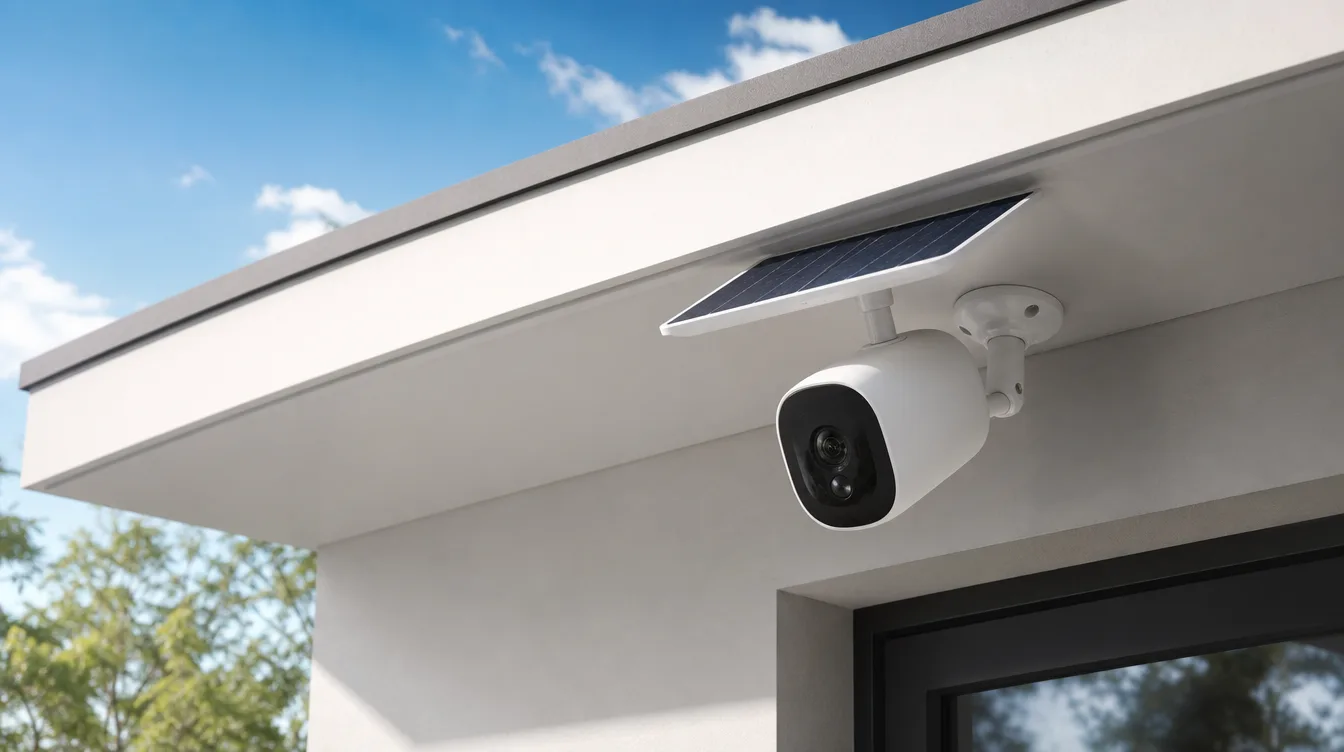
eufyCam S3 Pro Review: 4K, Solar, and No Subscription for the Flagship
4K UHD (3840×2160)
MaxColor, full color
Solar + 13,000mAh battery
HomeBase 3, up to 16TB local
Pros
- True 4K resolution with MaxColor full-color night vision, no spotlight needed
- Solar charging with a 13,000mAh battery for effectively set-and-forget power
- Included HomeBase 3 stores everything locally, expandable to 16TB, no fee
- Radar plus PIR detection cuts false alerts and adds facial recognition
Cons
- High upfront cost compared with single subscription cameras
- Footage lives on the included HomeBase, so placement affects theft risk
- Facial recognition and full features depend on the HomeBase 3
Best for
- Buyers who want a 4K outdoor system they own outright, no cloud bill
- Larger properties needing solar-powered, wire-free cameras
- Households ready to invest up front to avoid years of monthly fees
Spec comparison
| Spec comparison | eufyCam S3 Pro 2-Cam Kit | Amcrest IP5M-T1179EW | Arlo Pro 5S 2K |
|---|---|---|---|
| Resolution | 4K UHD (3840×2160), 1/1.8" sensor, f/1.0 | 5MP (2592×1944), 1/2.7-inch CMOS | 2K HDR |
| Night Vision | MaxColor full-color, plus adaptive spotlight and infrared | — | Color (integrated spotlight) |
| Power | Solar (SolarPlus 2.0) with 13,000mAh battery per camera | Power over Ethernet, requires a PoE switch or injector (not included) | Rechargeable swappable battery |
| Storage | HomeBase 3 (16GB built-in, expandable to 16TB local), no fee | microSD up to 256GB, Amcrest NVR, NAS, FTP or PC, no fee required | Cloud recording with an Arlo Secure plan (trial included); local storage with compatible SmartHub/Base Station (VMB4000, VMB4500, VMB4540, VMB5000) |
| Detection | Radar + PIR dual detection, facial recognition, IP67 | — | — |
| Field of view | 135° (112° horizontal, 60° vertical) | 132° super-wide | 160° |
| Connectivity | 802.11b/g/n Wi-Fi (2.4 GHz) | Wired PoE (single Ethernet cable carries power and data); works with Amcrest Surveillance Pro, Blue Iris and mainstream browsers | Dual-band Wi-Fi |
| Weather rating | IP67 | — | Weather-resistant, operating temperature -4°F to 113°F (-20°C to 45°C) |
| Subscription | Not required | Not required | Required |
| Warranty | 12 months (eufy security camera warranty) | 1-year replacement warranty with 30-day money-back guarantee (Amcrest US) | Limited hardware warranty, generally one year from date of purchase |
| Dimensions | 69 × 82.4 × 143.5 mm | 3.7 × 3.7 × 3.2 in, 1.04 lbs | 3.5 × 2.0 × 3.0 in (89 × 52 × 78.4 mm) |
| Night vision | — | Infrared LEDs, up to 98 ft (30 m) | — |
| Weatherproofing | — | IP67 | — |
Methodology & sources
TestedThis review is backed by a validated long-term test record retained by Lena Carter.
Verified on August 8, 2026
Most premium security camera systems bury a recurring bill in the fine print. The cameras are excellent, the app is slick, and then the 4K footage, the smart alerts, and the saved history all depend on a cloud plan that recurs every year for a multi-camera setup. The eufyCam S3 Pro 2-Cam Kit takes the opposite bet: pay more once for the hardware, and pay nothing after. It ships with a HomeBase 3 that stores every recording locally, up to 16 terabytes of it, and eufy charges no monthly fee for the cameras' core features. It is the most expensive product on this site, and the entire case for it rests on what you never pay again.
This review reads the S3 Pro against eufy's published specifications and the way its local-storage model actually works. Because this site exists to be honest about subscriptions, the no-fee promise is examined first, then weighed against the real costs of a system you own end to end.
4K resolution and MaxColor night vision
Each camera captures true 4K Ultra HD (3840 by 2160) through a large 1/1.8-inch stacked CMOS sensor with an f/1.0 aperture and a 135-degree field of view, with up to 8x digital zoom. The wide aperture is the specification that matters most after dark, because it lets the sensor gather far more light than a typical security camera before any illumination is added.
That feeds the system's standout feature, which eufy calls MaxColor Vision. Rather than dropping to grainy monochrome infrared at night, the S3 Pro renders full-color footage in low light without needing a spotlight to do it. The practical value is enormous for a security camera: color is what turns "a person in a dark jacket" into "a person in a red jacket," and it makes a nighttime clip describable in a way infrared never is. When light drops to near-total darkness, the camera can fall back on an adaptive spotlight or standard infrared, so it degrades gracefully rather than going blind. This is the capability that led reviewers such as Tom's Guide to call the S3 Pro one of the best 4K security cameras you can buy without a subscription.
Solar power that actually keeps up
Wire-free cameras live or die on battery management, and the S3 Pro is built to make charging a non-issue. Each camera carries a large 13,000mAh battery and pairs it with eufy's SolarPlus 2.0 panel. eufy's design target is a system that harvests more energy than it uses: with roughly an hour of direct sunlight a day, the company states the cameras can run for up to a year on a charge, and under full sun the panel can collect several hundred milliamp-hours per day against the 100 to 200 the camera typically consumes in a day and night of average activity.
As with any solar camera, that balance depends on where you mount it. A south-facing wall that catches real sun will keep the battery topped up indefinitely; a shaded corner or a long stretch of overcast winter days tips the math the other way and you will eventually recharge over USB. The generous battery gives a lot of buffer either way, which is what makes the "install it and forget it" promise realistic for most placements.
Detection, and the HomeBase 3 that anchors it all
The S3 Pro uses a dual detection system, combining radar with a passive infrared (PIR) sensor. Radar picks up motion PIR can miss and helps the system reason about what actually moved, which eufy credits with cutting false alerts by up to 99 percent. In practice, fewer junk notifications is the difference between a camera you trust and one whose alerts you learn to ignore.
The kit's real engine is the included HomeBase 3 (the S380). Every recording lands there, on 16GB of built-in storage that expands up to 16 terabytes locally, and the HomeBase is where facial recognition runs so the system can tell a household member from a stranger. This is the piece that replaces the cloud: the AI processing and the storage that competitors rent to you monthly both live on a box in your home. It is also worth noting the S3 Pro is designed to work specifically with the HomeBase 3, so the kit is a complete system rather than cameras you bolt onto older hardware. The cameras themselves are IP67-rated against rain and dust, and a dual-microphone array with AI noise reduction picks up two-way audio out to about 26 feet.
The no-fee math, stated plainly
Here is the part that justifies the price tag. There is no eufy plan gating the S3 Pro's 4K recording, its MaxColor night vision, its radar detection, or its facial recognition; all of it runs off the HomeBase you already paid for. Set that against a subscription system: a multi-camera cloud plan such as Ring Home Standard, or Google Home Premium for a Nest setup, is billed every month, indefinitely, on top of the cameras. Across the years a security system actually lives on a house, those fees add up to more than the kit costs once. The S3 Pro asks for a larger payment up front and then never sends another invoice, which is exactly the trade a long-term owner wants.
What you give up without a subscription
Owning your footage instead of renting cloud space is the right call for most buyers, but it comes with honest trade-offs worth naming. First, the storage is at your house: a HomeBase can be stolen or damaged along with the cameras, whereas a cloud plan keeps an off-site copy the moment a clip is captured. Placing the HomeBase somewhere discreet indoors mitigates this, but it is a real difference. Second, there is no professional monitoring in the box; this is a self-monitored system, so alerts come to your phone rather than to a monitoring center that dispatches help. Third, the flagship features depend on the HomeBase 3, so this is a system you commit to rather than a single camera you sprinkle around. For a household comfortable managing its own security, none of these outweigh never paying a fee again, but they are the things the monthly bill was quietly covering.
The eufy privacy question, in context
An honest eufy review has to address the 2022–2023 episode, when a researcher showed eufy uploading facial-recognition thumbnails to the cloud despite marketing that leaned on local storage, and demonstrated that some streams could be viewed in an unencrypted state. Anker, eufy's parent, patched the flaws, moved live viewing behind a secure web portal, and revised its privacy wording afterward. The takeaway for a buyer today is to treat "local storage" as a claim to understand rather than assume: the S3 Pro genuinely records to the HomeBase in your home, but preview thumbnails and remote access still pass through eufy's servers to reach your phone. That is normal for a cloud-connected camera, but a buyer whose hard requirement is that nothing ever leaves the property should know where the line sits.
Who should buy it
The S3 Pro is the right system for a buyer who wants flagship 4K coverage of a house or a larger property and refuses to pay monthly for it. It suits homeowners who can mount cameras and a HomeBase, who value color night vision and low false-alert rates, and who are comfortable spending more up front to erase years of subscription cost. It anchors the premium end of a no-fee setup in a way a single budget camera cannot.
Who should skip it
Buyers on a tight budget who just want one camera watching a doorway should start with something far cheaper. Renters unwilling or unable to install a HomeBase and mounted cameras will find it heavier than they need. And anyone who specifically wants footage held off-site in the cloud, for theft resilience or for professional monitoring, is shopping for a different model of security than this system offers.
How it compares
Against the eufy SoloCam S340 reviewed here, the S3 Pro is the step up in nearly every direction: true 4K instead of a dual-lens 3K, MaxColor night vision, radar detection, and a HomeBase that expands storage to terabytes rather than the SoloCam's built-in 8GB, at a correspondingly higher price. Against a subscription flagship such as the Arlo Pro 5S, the eufy trades some cloud polish and services for outright ownership of its footage and the absence of any recurring bill. The SoloCam is the pick for one wide-area camera; the S3 Pro is the pick when the goal is a whole no-fee 4K system built to last.
Verdict
The eufyCam S3 Pro 2-Cam Kit is the flagship no-subscription outdoor system this site was waiting to recommend. Its 4K sensors and MaxColor night vision produce the kind of usable, describable footage most cameras only manage with a spotlight, the solar-and-battery combination makes charging a non-issue in a decent placement, and the included HomeBase 3 turns the whole thing into a system you own rather than rent, with local storage that scales to 16 terabytes. The price is real and the local-only storage carries a theft trade-off worth planning around, but measured over the years a security system actually lives on a house, paying once and never again is exactly the deal this kit delivers.
Frequently asked questions
Is there really no monthly fee for the eufyCam S3 Pro?
Correct. The kit includes a HomeBase 3 that stores recordings locally and runs the AI features, so 4K recording, MaxColor night vision, radar detection, and facial recognition all work with no eufy plan. The only ongoing cost is the electricity the HomeBase uses.
Where does the footage go, and is it safe if a camera is stolen?
Recordings are saved on the HomeBase 3 in your home, expandable up to 16TB, not in the cloud by default. That means there is no off-site copy unless you add one, so a thief who takes the HomeBase takes the footage. Mounting cameras out of reach and placing the HomeBase somewhere discreet indoors is the standard way to reduce that risk.
Do the solar cameras need constant sunlight to work?
No. Each camera holds a large 13,000mAh battery, and eufy states roughly an hour of direct sun a day is enough to keep it charged, with up to a year of runtime on a full charge. In a shaded spot you will occasionally recharge over USB, but the big battery gives plenty of buffer.
Does the system keep recording if your internet drops?
Yes. Because the HomeBase 3 stores footage locally, the cameras keep recording during an internet outage. You temporarily lose remote viewing and notifications until the connection returns, but nothing that happens at the cameras is lost.
Editorial summary
The eufyCam S3 Pro 2-Cam Kit pairs 4K MaxColor night vision and solar power with a HomeBase 3 that stores everything locally, delivering a flagship no-subscription outdoor system.
Where to buy
Check the merchant for the current price and availability. We may earn a commission.